5 Year Old Not Listening? 7 Expert Strategies for School-Age Cooperation


Table of Contents
Your 5-year-old can explain every house rule in perfect detail. They can tell you that hitting is wrong, that we use indoor voices inside, that screen time ends when the timer goes off, and that we brush teeth before bed. They can even explain why these rules exist with impressive logic.
And then they break every single one of them before noon.
This is the paradox of parenting a 5-year-old: they understand everything you say and still act as if they heard nothing. If you've found yourself locked in a cycle of repeating, reminding, warning, and eventually losing your patience with a child who clearly knows better, you're in the right place.
Here's what no one tells you: the gap between understanding rules and consistently following them is not a character flaw. It's a neurodevelopmental reality. And once you understand it, you can stop battling your child and start building the kind of cooperation that actually sticks.
- ✓At 5, children know the rules but can't consistently execute them — the knowing-doing gap is neurological, not a character flaw
- ✓Kindergarten drains compliance reserves; after-school resistance is often executive function fatigue, not defiance
- ✓Involve them in rule-making — people of all ages follow rules they helped create far more than rules imposed on them
- ✓Use visual checklists, "when/then" bridges, and sportscaster narration to move authority off your voice and onto shared structures
- ✓Follow through with empathy, not anger — the boundary plus the warm connection is what teaches
The 5-Year-Old Brain: Why Knowing and Doing Are Worlds Apart
The Knowing-Doing Gap
Imagine you know exactly how to eat healthily. You can name all the nutrients, explain why vegetables matter, and give a perfect lecture on the importance of hydration. Now think about the last time you ate chips for dinner because you were tired.
That is the knowing-doing gap, and it's exactly what your 5-year-old experiences dozens of times a day. Their intellectual understanding of rules has raced far ahead of their brain's ability to consistently execute them, especially when emotions, fatigue, or excitement enter the picture.
Dr. Adele Diamond, a neuroscientist at the University of British Columbia, has spent decades studying executive function in children. Her research shows that at age 5, children can articulate rules clearly but their prefrontal cortex — the brain region that turns knowledge into action — is still developing its connections. Under ideal conditions (calm, rested, motivated), a 5-year-old can follow rules beautifully. Under stress, fatigue, or excitement, those same rules become temporarily inaccessible.
What's Developmentally New at Age 5
Several factors make this age uniquely challenging for listening:
Social awareness is exploding. Your child is now deeply aware of peers, fairness, and social dynamics. They compare your rules to their friends' rules: "But Olivia's mom lets her have screen time during dinner!" This isn't manipulation — it's genuine cognitive development as they try to understand why different families have different rules.
Logical thinking is emerging. Five-year-olds are beginning to reason logically, which means they question arbitrary-seeming rules. When you say "Because I said so," their developing brain genuinely finds this unsatisfying. They need reasons, and they're learning to argue for what they want.
Independence needs are shifting. Unlike a 2-year-old's "No!" phase, a 5-year-old's resistance is more sophisticated. They want genuine input into decisions that affect them. Being told what to do without any say feels increasingly wrong to them, even if they can't articulate why.
The school effect. If your child is in kindergarten, they're spending hours each day following structured rules with teachers. By the time they get home, their compliance reserves are depleted. What looks like not listening may actually be executive function fatigue — they've used up their self-regulation energy at school and have nothing left for you.
Understanding these power dynamics helps you see your child's behavior as communication rather than defiance.
7 Strategies for 5-Year-Old Not Listening: Building Real Cooperation
1. Make Them Part of the Rule-Making Process
Five-year-olds cooperate far more with rules they helped create than rules imposed on them. This doesn't mean they run the household — it means they have a voice.
How to do it:
Hold a family meeting (keep it short — 10 minutes max). Use questions like:
- "What rules do you think our family needs to have a good morning?"
- "What should happen when someone forgets a rule?"
- "How much screen time do you think is fair?"
Write down their ideas. You'll be surprised how reasonable most of them are. Where their suggestion differs from what you need, negotiate: "I love that idea. What if we changed it slightly to include..."
Script for the conversation: Parent: "I've noticed mornings have been really hard for both of us. I want to figure out a plan together that works for our whole family. What do you think would help mornings go smoother?"
Child: "I don't want to get dressed first thing."
Parent: "OK, that's interesting. When would you like to get dressed?"
Child: "After breakfast."
Parent: "Let's try that this week and see how it works. Deal?"
Why it works: Research from the University of Rochester shows that people of all ages — including children — are more motivated to follow rules when they feel autonomous in creating them. This taps into intrinsic motivation rather than external compliance.
Parent story — Devon's experience: "We were having daily screaming matches about cleanup time until I asked my 5-year-old Zara to help make the rules. She decided that cleanup should happen to music and that she gets to pick the song. She also chose the consequence for not cleaning up — no bedtime story. She follows her own rules so much better than mine. I think she just needed to feel like her opinion mattered."
2. Use Visual Checklists Instead of Verbal Reminders
At 5, your child can read simple words and pictures. Move your instructions off your voice and onto something they can see and reference independently.
Morning Routine Checklist:
- Get dressed (picture of clothes)
- Eat breakfast (picture of plate)
- Brush teeth (picture of toothbrush)
- Pack backpack (picture of bag)
- Put on shoes (picture of shoes)
How to make it work:
- Let your child help create and decorate the checklist
- Use checkboxes or moveable magnets they can interact with
- Refer to the chart instead of nagging: "What's next on your checklist?" instead of "Go brush your teeth!"
- Celebrate when they complete it independently
Why it works: Visual checklists shift the authority from you to the chart. You're no longer the nagging parent — you're the supportive coach pointing to the plan they helped create. This preserves your relationship while maintaining accountability.
3. Replace Commands with Collaborative Problem-Solving
Five-year-olds who feel bossed around will resist. Five-year-olds who feel consulted will cooperate. The shift from commanding to collaborating transforms the dynamic entirely.
The Problem-Solving Formula:
- Empathize: "I notice you're having a hard time turning off the TV when the timer goes off."
- Define the problem: "The problem is that when TV goes past the time, there's no time left for stories before bed."
- Invite solutions: "What could we do to solve this?"
- Evaluate together: "Let's pick the idea that works for both of us."
This approach, developed by Dr. Ross Greene in his book The Explosive Child, treats your child as a partner rather than an adversary. Most 5-year-olds come up with surprisingly thoughtful solutions when asked.
Script example: Parent: "I've been noticing that getting out the door for school has been really stressful for both of us. I don't want to yell and I know you don't want to be rushed. Can we figure this out together?"
Child: "I don't like when you say 'hurry up' a million times."
Parent: "That makes sense. I don't like saying it either. What if we set a timer and you can see how much time is left? Would that help?"
Child: "Yeah. And can I pick my own clothes the night before?"
Parent: "Great idea. Let's try both of those tomorrow."
4. Offer the "When...Then" Bridge
This strategy reframes your request as a logical sequence rather than a demand, which respects a 5-year-old's growing need to understand why.
Instead of: "Stop playing and set the table." Try: "When the table is set, then we can eat that pasta you've been excited about."
Instead of: "Do your homework now." Try: "When homework is finished, then you can choose a game for us to play together."
Instead of: "Clean up your room." Try: "When your room is picked up, then we can have our movie night."
The key difference from bribery: You're not adding a reward — you're simply explaining the natural sequence of events. Dinner comes after the table is set. Free time comes after responsibilities are done. This teaches logical thinking and personal responsibility.
From the app
Ask about your own situation
Noah (4) ignores everything I say until I raise my voice. How do I get him to listen without yelling?
Summary
Noah is probably not ignoring you on purpose: at four, an instruction called across the room rarely reaches a child who is deep in something else. Go over to him, get his attention first, and then say it once.
What to do
- Get close first: Walk over, crouch to his level and wait until he looks at you. "Noah, I need your eyes for a second."
- One instruction, once: Say what happens, not what has to stop. "Shoes on, then we go." No repeating and no counting down.
- Follow through calmly: If nothing moves, help him do it. "I said shoes on. I am going to help you now." Same voice as the first time.
Answers for your own situation are part of Premium, with a free trial. The scripts stay free.
5. Use the "Sportscaster" Narration Technique
Instead of repeating commands, narrate what you observe and what needs to happen — like a sports commentator describing a game. This removes the power struggle entirely because you're not commanding; you're observing.
Instead of: "I told you to put your shoes on three times already!" Try: "I see someone in socks who needs to be in shoes in two minutes. I wonder how that's going to happen..."
Instead of: "Stop fighting with your sister!" Try: "I'm seeing two kids who both want the red marker. That's a tough problem. I wonder how they'll solve it."
Instead of: "You haven't touched your dinner." Try: "I notice the broccoli is still on the plate. Bodies need fuel to play after dinner."
Why it works: The sportscaster approach removes the adversarial dynamic. You're not the enforcer — you're the narrator. This allows your child to become the hero of their own story by choosing to cooperate, rather than the subordinate following orders.
Parent story — Michael's experience: "I used to repeat myself until I was blue in the face trying to get my 5-year-old Noah ready for bed. Now I just narrate: 'I see a boy who hasn't brushed his teeth yet, and bedtime is in 10 minutes. His dinosaur book is waiting for him after teeth are brushed.' He started doing it on his own by day three. I think he likes being the one who decides to act, not the one being told to act."
6. Create Role-Reversal Moments
Five-year-olds love being in charge. Give them structured opportunities to lead, and they'll be far more willing to follow when it's your turn.
The Boss Hour: Designate 20-30 minutes on weekends where your child makes the family decisions (within safe boundaries). They choose the snack, the activity, and who does what. This fills their "autonomy tank" so they have less need to fight for control during the week.
The Teacher Game: Let your child "teach" you the rules. "Can you show me the right way to set the table? I keep forgetting." This lets them demonstrate competence and reinforces the rules without you repeating them.
The Role Swap: Act out challenging scenarios where they play the parent and you play the child. Let them experience both sides. This builds empathy and often produces hilarious moments that diffuse ongoing tension.
Parent story — Nadia's experience: "My daughter Isla was pushing back on every single request. I started letting her be 'the mom' for 15 minutes each evening. She bosses me around (gently — she's actually a strict but fair leader!) and gets it out of her system. The next morning, she's so much more willing to cooperate. I think she just needed to feel powerful."
7. Follow Through with Empathy, Not Anger
When your 5-year-old doesn't listen after you've tried everything, the temptation to escalate — to yell, threaten, or punish — is real. But at this age, how you follow through matters as much as the follow-through itself.
The Empathetic Follow-Through Formula:
- Acknowledge their feelings: "I know you don't want to stop playing."
- Hold the boundary: "And it's time to come inside."
- Follow through with action: Calmly walk over and begin the transition.
- Avoid lecturing: Keep it brief. One sentence of empathy, one sentence of boundary.
What this sounds like: "I can see you're having so much fun out here. It's really hard to stop. And dinner is ready, so it's time to go in. Would you like to walk or would you like me to race you to the door?"
What to avoid:
- "I've told you five times already!" (Shaming)
- "Why can't you ever listen?" (Character attacks)
- "Fine, no dessert tonight." (Disconnected punishment)
- "You're making us late again." (Guilt)
I've told you five times! Why can't you just listen?!
I can see it's hard to stop. And it's time. Would you like to walk or race me to the door?
For children whose non-compliance comes with intense emotional reactions, the emotional roots of resistance — big feelings, unmet needs, loss of control — often matter more than the behavior itself, and addressing those roots constructively is what actually moves the needle.
When "Not Listening" May Signal Something Deeper
Red Flags That Warrant Professional Attention
Occasional selective listening is a universal experience of parenting a 5-year-old. However, consult your child's pediatrician if you notice:
Attention and focus concerns:
- Inability to focus on any enjoyed activity for 10-15 minutes
- Constant fidgeting and restlessness beyond typical 5-year-old energy
- Consistent difficulty following even single-step instructions when calm and motivated
- Significant teacher feedback about attention and focus at school
- These patterns persist across all settings, not just at home
Processing and comprehension concerns:
- Frequently seems confused by simple instructions
- Asks "What?" repeatedly even in quiet one-on-one settings
- Struggles with age-appropriate conversations
- Difficulty remembering routines they've done hundreds of times
Emotional and behavioral concerns:
- Extreme meltdowns (lasting 30+ minutes) that happen daily
- Aggressive behavior when given any instruction
- Severe anxiety about normal transitions or expectations
- Marked regression in skills or behavior
If your child's behavior is accompanied by anxiety, our childhood anxiety guide can help you understand the connection between worry and non-compliance.
From the app
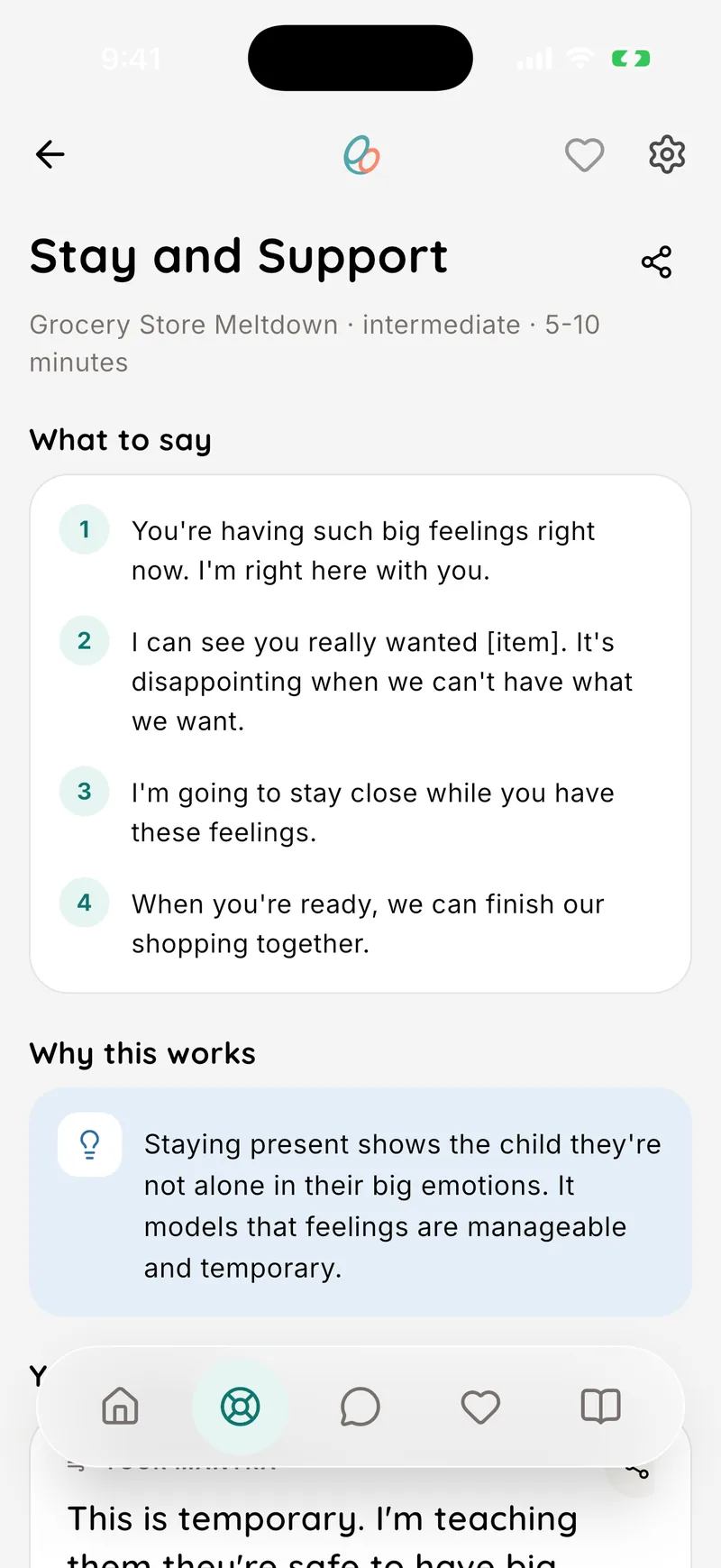
What to say when it happens
Child sasses, refuses, or talks back defiantly in front of other people - other parents, family, a checkout line - and you feel the stares
Ages 3-7 years
Say this
- 1You really don't want to. Tell me the worst part.
- 2You wish this didn't have to happen right now. I get it.
- 3That part's still happening. You pick - do we walk to the car, or do I carry you like a sack of potatoes?
- 4That was a big feeling, and it came out unkind. Try it again - I'm listening.
Why it works
All 36 scripts are free in the app, no account needed.
Your 4-Week Kindergarten Cooperation Plan
Week 1: Shift from Commanding to Collaborating
- Hold your first family meeting about one problem area (mornings, bedtime, or screen time)
- Let your child help create at least one new rule or routine
- Practice the "When...Then" bridge for all transitions
- Track: How many times do you repeat yourself per day? (Just notice — no judgment.)
Week 2: Install Visual Systems
- Create one visual checklist together (start with the most challenging routine)
- Replace at least three verbal reminders with "What's next on your chart?"
- Try the sportscaster technique once per day
- Track: How often does your child reference the checklist independently?
Week 3: Build Autonomy and Connection
- Start the Boss Hour or Role Swap on the weekend
- Let your child teach you the rules for one routine
- Practice empathetic follow-through — validate feelings before holding boundaries
- Track: Do you notice fewer power struggles on days with role-reversal time?
Week 4: Refine and Celebrate
- Note which strategies work best for your specific child
- Let go of strategies that don't feel natural for your family
- Celebrate progress with your child: "Our mornings have been so much smoother. Your checklist idea really works!"
- Plan the next area to tackle together
What to Expect: A Realistic Timeline
Week 1: You'll feel awkward trying new approaches. Your child may test the boundaries of the new system. This is normal — they're checking if this is a temporary thing or a real change.
Week 2-3: You'll start to see cooperation in the areas where you've implemented visual systems and collaborative rules. Other areas may still be challenging. Progress is not linear.
Month 2: A clear shift emerges. Your child starts referencing rules they helped create. Power struggles decrease noticeably. You find yourself yelling less.
Month 3 and beyond: Cooperation becomes the household norm for most daily routines. Hard days still happen, but they're exceptions rather than the pattern. Your child begins to internalize the problem-solving approach and starts resolving their own conflicts with siblings and friends.
Your Next Steps
Parenting a 5-year-old who won't listen can feel like an endless negotiation, but the work you do now has enormous payoff. The collaborative skills, emotional regulation, and internal motivation you're building will serve your child through elementary school and beyond.
Pick the strategy that resonates most with your family. If mornings are your biggest battle, start with a visual checklist. If power struggles dominate your evenings, try the family meeting approach. You don't need to overhaul everything at once — one meaningful change is enough.
For age-specific scripts and scenarios, our positive discipline examples for 5-year-olds offer word-for-word guidance you can use today. If your child has been hitting or becoming physical when frustrated, our child hitting guide addresses that specific behavior pattern.
To understand the broader pattern of why children of all ages tune parents out, explore our guide on why children ignore parents, which covers the cooperation gap across the early childhood years.
You're doing harder work than most people realize. And the fact that your 5-year-old argues back, questions your rules, and pushes for independence? That means you're raising a thinker. Channel it, don't crush it — and both of you will come out stronger on the other side.
For age-ladder context, see our 4-year-old not listening guide for the previous stage, or our 6-year-old not listening guide for what the next year brings.
Frequently Asked Questions
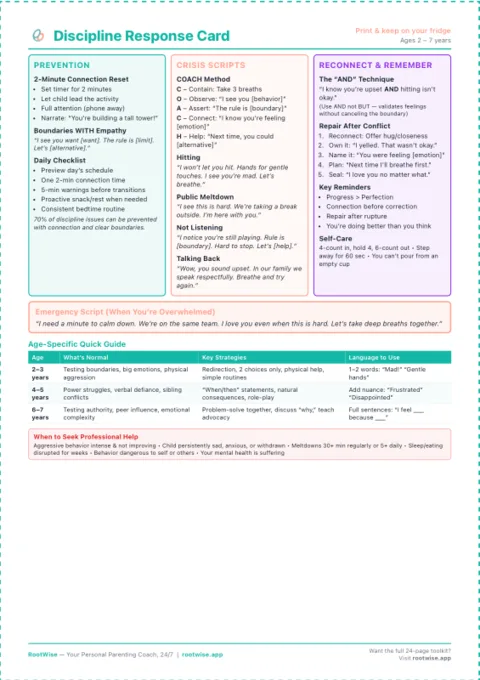
Boundary Setting Scripts
No spam, ever. Unsubscribe in one click.
Need personalized support?
Ask RootWise about your own situation and get an answer for your child's age, 24/7, when you need it most.
Get the app