2 Year Old Not Listening? Why It's Normal and 8 Ways to Build Cooperation

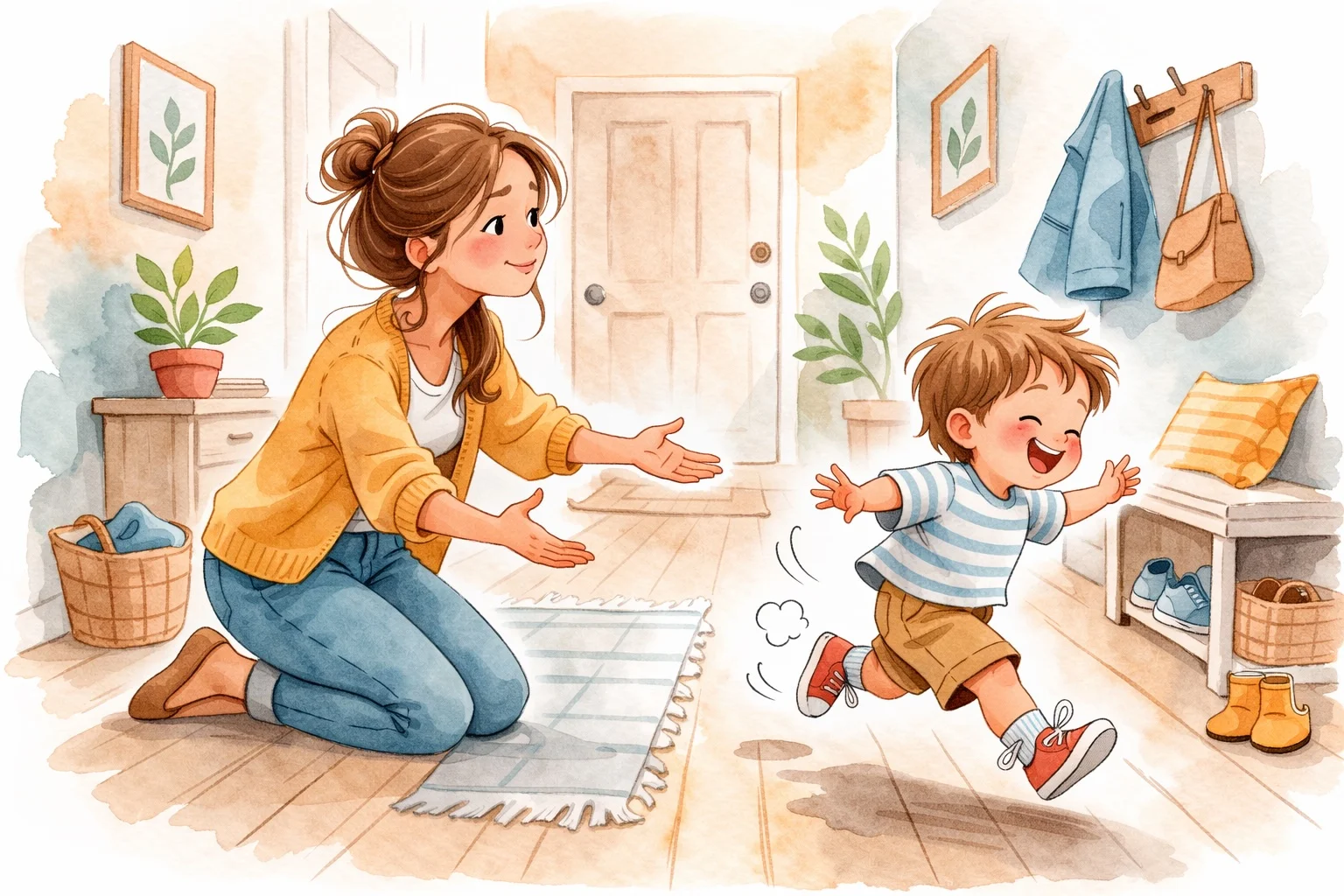
You say "Come here, please" and your 2-year-old looks straight at you, grins, and sprints in the opposite direction. You say it again. They laugh harder and run faster. By the twelfth time, you're standing in the hallway wondering whether your toddler has genuinely lost the ability to hear or is simply the most stubborn person you've ever met.
Take a deep breath. You are not raising a disobedient child. You are raising a completely normal 2-year-old whose brain is wired to explore, test, and assert independence above almost everything else. The behavior that feels like deliberate defiance is actually one of the healthiest developmental milestones your child will ever hit.
In this guide, you'll learn exactly what's happening inside your toddler's brain when they tune you out, why the strategies you've been using might be making things worse, and 8 evidence-based approaches that build real cooperation — starting today.
- ✓Your 2-year-old's brain literally cannot process requests the way you expect
- ✓"Not listening" is developmental, not defiance — the prefrontal cortex is barely online
- ✓Get close, get low, and connect before giving any instruction
- ✓Offer choices, keep it simple, and follow through with calm action instead of more words
Why Your 2-Year-Old Doesn't Listen (It's Not What You Think)
Their Brain Is Still Under Construction
Here is the most important thing to understand: your 2-year-old's prefrontal cortex — the part of the brain responsible for impulse control, working memory, attention, and following directions — is in the very earliest stages of development. It will not be fully mature until their mid-twenties.
At age 2, this means your child literally cannot:
- Hold more than one instruction at a time in working memory
- Override a strong impulse (like grabbing a toy or running) just because you asked them to stop
- Shift attention voluntarily from something fascinating to something boring
- Understand time — "in five minutes" is meaningless to them
This isn't a choice they're making. It's a limitation of the hardware they're working with.
The Autonomy Explosion
Around 18 to 24 months, children enter what developmental psychologists call the "autonomy stage." Your toddler has just discovered a thrilling truth: they are a separate person with their own will. The word "No!" isn't defiance — it's their first declaration of selfhood.
Dr. Alison Gopnik, a leading developmental psychologist at UC Berkeley, describes this stage as the child's "experiment with agency." Every time your 2-year-old refuses a request, they are running a small experiment: What happens when I do what I want instead of what you want?
This is the same impulse that will one day help them stand up for themselves, make independent decisions, and think critically. Right now, though, it looks like running away from you laughing while you hold their coat.
Emotional Flooding Shuts Down Listening
Two-year-olds experience emotions at full intensity with almost no ability to regulate them. When they're excited about playing, disappointed about leaving the park, or overwhelmed by a transition, their emotional brain takes over completely and their listening brain goes offline.
This is why your toddler can seem to "hear" the word "cookie" from three rooms away but appears deaf when you say "time to go." Their brain prioritizes emotionally relevant information and filters out everything else.
Understanding the emotional side of these moments becomes even easier with our toddler tantrums guide, which explains how meltdowns and non-compliance are deeply connected.
Sensory Absorption Is Real
When your 2-year-old is pouring water back and forth between cups, stacking blocks, or watching ants crawl on the sidewalk, they can enter a state of deep concentration that genuinely filters out external sounds. Researchers call this "flow state," and young children access it more readily than adults. Your toddler is not pretending they can't hear you — in that moment, they may genuinely not be processing your words.
8 Strategies That Build Cooperation (Without Yelling or Punishment)
1. Get Close, Get Low, Get Connected
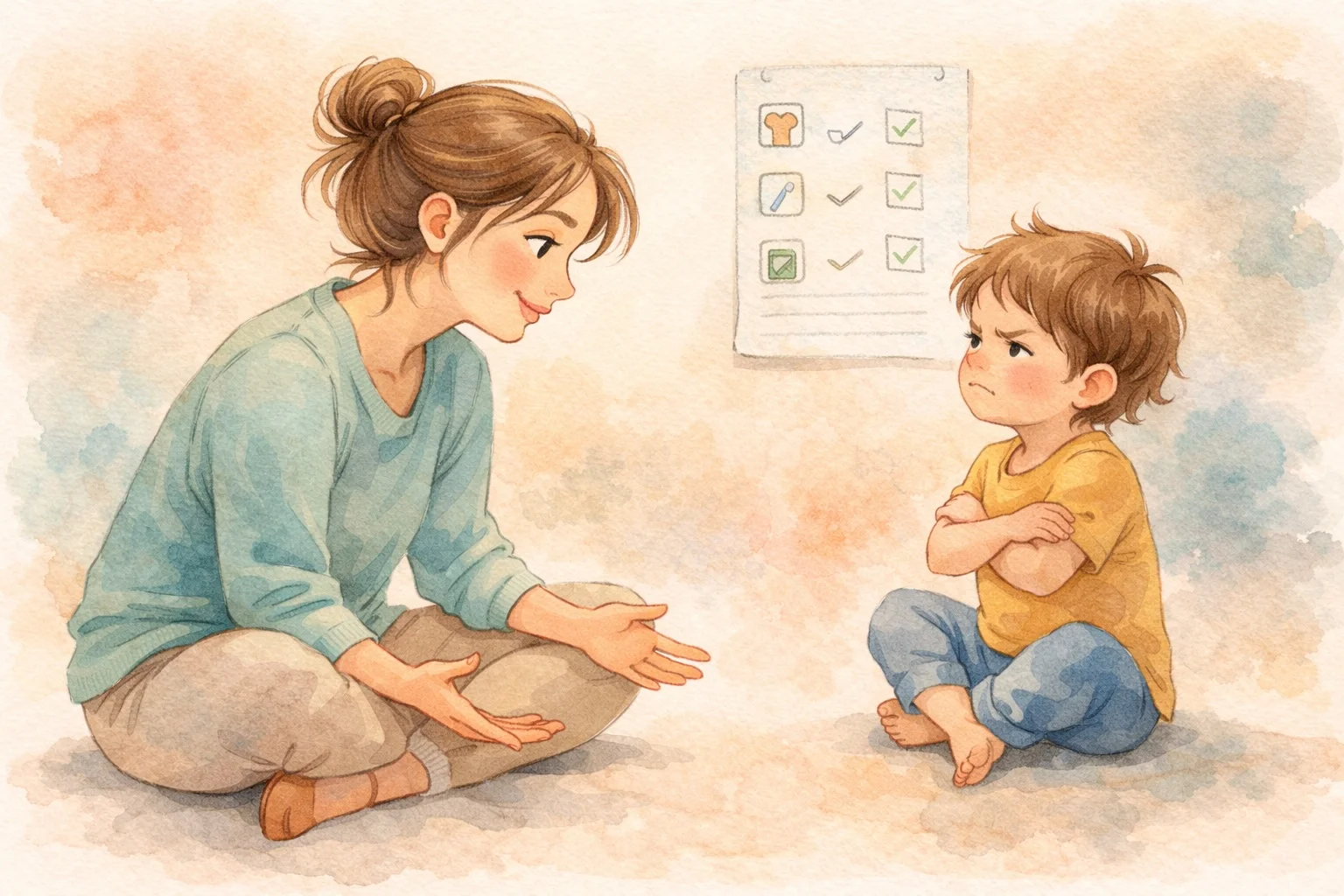
The single most effective change you can make is to stop giving instructions from across the room.
The Close-Low-Connected Method:
- Walk over to your child (every single time)
- Crouch or kneel so you're at their eye level
- Gently touch their arm or shoulder
- Wait for eye contact — even if it takes a few seconds
- Then speak your request in a calm, clear voice
Script: Instead of shouting "Come eat lunch!" from the kitchen, walk over, kneel beside them, touch their hand, and say: "You're working so hard on that puzzle. Lunch is ready now. Time to eat."
Why it works: Physical closeness activates your child's social attention system. Eye contact and touch signal that this moment requires their focus. Research from the University of Iowa found that toddlers are 80% more likely to comply with a request delivered at eye level with physical touch than one called from a distance.
2. Keep Instructions Impossibly Simple
Your 2-year-old's working memory can hold exactly one piece of information at a time. Treat every instruction like a text message with a strict character limit.
OK, we need to stop playing, put our toys in the basket, go upstairs, wash our hands, and sit down at the table.
Toys in the basket." (Pause. Wait. Help if needed.) Then: "Now let's go upstairs.
The one-step version works because their working memory can only hold one instruction at a time.
The one-step rule: If your instruction has the word "and" in it, it's too long. Split it into separate steps and wait for each one to be completed before giving the next.
3. Harness the Power of "No" by Offering Choices
Since your 2-year-old is driven by the need to assert autonomy, the fastest way to gain cooperation is to give them legitimate power within your boundaries.
Instead of: "Put your shoes on." Try: "Red shoes or blue shoes?"
Instead of: "Time for bath." Try: "Do you want to walk to the bathtub or should I carry you like a sack of potatoes?"
Instead of: "Eat your dinner." Try: "Banana first or pasta first?"
The rule: Both options must be acceptable to you. You're not negotiating — you're offering curated autonomy.
4. Use Playfulness as Your Secret Weapon
At age 2, play is your child's primary language. When you translate a boring request into something playful, you bypass resistance entirely.
The Silly Voice: Make your request in a goofy voice. "The tickle monster says it's time to put on pajamas!"
The Race: "Can you put the blocks in the box before I finish singing the ABCs?"
The Pretend Game: "Let's stomp to the bathroom like dinosaurs! STOMP STOMP STOMP!"
The Reverse Psychology Play: "Don't you dare put that sock on your foot! No way you can do it!" (Watch them rush to prove you wrong.)
Parent story — Rachel's experience: "My son Eli refused to get in his car seat every single day until I started saying 'Beep beep! The Eli rocket needs to get in the launch seat!' He now runs to the car and climbs in himself, making rocket sounds. What used to be a 10-minute battle takes 30 seconds."
5. Replace "No" and "Don't" with What You Want to See
A 2-year-old's brain struggles to process negative instructions. When you say "Don't touch that," their brain has to first imagine touching it, then try to override that image. The result? They touch it.
Instead of: "Don't throw your food!" Try: "Food stays on the plate."
Instead of: "No running!" Try: "Walking feet inside."
Instead of: "Stop screaming!" Try: "Quiet voice, please."
Instead of: "Don't climb on that!" Try: "Feet on the floor."
This tiny language shift can dramatically reduce how often your toddler seems to "ignore" you. In many cases, they weren't ignoring — they simply couldn't process the negative instruction fast enough.
6. Transition Warnings: Give Their Brain a Heads-Up
Abrupt transitions are the number one trigger for 2-year-old non-compliance. Their brain needs time to shift gears.
The Two-Minute Warning System:
- First warning (2 minutes before): "Two more minutes of playing, then it's bath time."
- One-minute warning: "One more minute with the blocks."
- Transition cue: "OK, blocks are all done for today. Bath time!"
Physical transition cues work even better than verbal ones:
- Set a visual timer (sand timer works great at this age)
- Sing a specific "cleanup song" every time
- Use a consistent transition phrase: "All done, all done, blocks are all done!"
Parent story — James's experience: "We were having screaming meltdowns every time we left the playground until we started the 'two more things' approach. I tell my daughter Mia, 'You can do two more things — pick any two!' She chooses her two slides or swings, does them, and walks to the car. The predictability of it changed everything for us."
7. Follow Through with Calm Action, Not More Words
When your 2-year-old doesn't respond after one or two clear requests, stop talking and start doing. This is not punishment — it's gentle follow-through.
The pattern:
- Give the instruction once, clearly, at their level
- Wait 5-10 seconds
- If no response, calmly move to action
Example: "Time to put shoes on." (Wait.) No response. Walk over, sit beside them, and gently start putting their shoes on, narrating calmly: "I'm going to help you with shoes now. We're putting on the left one first."
8. Build a Connection Bank Account
Children cooperate more with people they feel deeply connected to. Think of your relationship as a bank account: every moment of warmth, laughter, and presence is a deposit. Every correction, direction, and "no" is a withdrawal. If you're making more withdrawals than deposits, cooperation drops.
Daily deposits that take 5 minutes or less:
- 10 minutes of child-led play where you follow their lead completely
- Narrate what they're doing with genuine interest: "You're stacking the red block on the blue one!"
- Physical affection without any agenda — just a hug, a cuddle, a silly dance
- Let them "help" you with something, even if it takes longer
Parent story — Anika's experience: "I started doing 10 minutes of 'special time' every morning where my 2-year-old Rohan picks the activity and I just follow along. No phone, no agenda. Within a week, he started cooperating so much more during the hard parts of the day. It's like filling up his connection tank gives him the willingness to go along with things he doesn't love."
For deeper strategies on building the emotional foundation that makes cooperation possible, explore our emotional safety first guide.
When "Not Listening" Might Be Something More
Most 2-year-olds who seem to ignore their parents are developing perfectly normally. However, there are certain signs that warrant a conversation with your pediatrician.
Hearing concerns — talk to your doctor if your child:
- Never responds to their name, even in quiet settings
- Doesn't startle at loud unexpected sounds
- Needs the TV volume significantly higher than others
- Has had frequent ear infections
Speech and language concerns:
- Says fewer than 50 words by age 2
- Doesn't combine two words together (like "more milk" or "daddy go")
- Seems unable to understand simple instructions even in calm, focused moments
Developmental and sensory concerns:
- Cannot focus on any activity for even 1-2 minutes
- Extreme reactions to sensory input (textures, sounds, lights)
- No pretend play or imitation of others
- Loss of skills they previously had
If any of these resonate, early intervention programs (available free in most areas) can provide support. Early identification makes a meaningful difference.
Your Week-by-Week Action Plan
Week 1: Close the Distance
- Commit to giving every instruction at your child's eye level with physical touch
- Track how many times they respond when you connect first versus calling from across the room
- Goal: No more shouting instructions from other rooms
Week 2: Simplify and Choose
- Practice one-step instructions only — no "and" allowed
- Offer two choices for every transition (getting dressed, mealtimes, leaving the house)
- Notice which types of choices your child responds to best
Week 3: Play Your Way Through
- Pick one daily flashpoint (car seat, getting dressed, bath time) and add a playful element
- Try the silly voice, the race, or the reverse psychology approach
- Track which playful strategies land best with your child
Week 4: Fill the Connection Bank
- Start 10 minutes of daily child-led "special time"
- Practice the follow-through method — one request, then calm action
- Celebrate any moment of cooperation, no matter how small: "You put your cup on the table! That was so helpful!"
What to Expect: A Realistic Timeline
Be patient with yourself and your child. Here is what most parents experience:
Days 1-3: Your child may be confused by the new approach. Old patterns persist. This is normal.
Week 1-2: Small moments of cooperation start to appear. You'll notice they respond faster when you get close and connect.
Week 3-4: A clear pattern emerges. Flashpoints that used to be daily battles happen less often. Your own stress level drops.
Month 2-3: Cooperation becomes the norm rather than the exception for everyday requests. You still have hard days — everyone does — but the baseline has shifted.
By age 3: With consistent practice, most children show dramatic improvement in their ability to listen, follow simple directions, and cooperate with routines. Our 3-year-old not listening guide covers the next developmental stage and how your strategies will evolve.
Your Next Steps
Raising a 2-year-old who doesn't listen is exhausting, but the fact that you're here reading this tells me you're already doing something right — you're looking for understanding, not just obedience. That matters more than you know.
Start with one strategy. Just one. The "Close-Low-Connected" method is the simplest and most powerful place to begin. Try it for three days and see what shifts.
If your child is closer to 3 or older, our 3-year-old not listening guide builds on these foundations with strategies tailored to the next developmental stage. And if you're wondering whether your child's behavior crosses the line from typical toddler resistance into something deeper, our understanding defiance guide can help you tell the difference.
For a broader look at why children of all ages seem to tune parents out, explore our guide on why children ignore parents, which covers the cooperation gap from ages 2 through 7.
You've got this. And your little runner who laughs while sprinting away from you? They love you more than anyone else in the world. That's exactly why they feel safe enough to say "no."
24/7 AI Parenting Assistant
Get instant, personalized advice with expert-curated parenting knowledge. Chat with your AI coach anytime, anywhere.

Challenging Moments Support
Access step-by-step parenting strategies, quick tips, and age-specific guidance for difficult situations when you need it most.
Boundary Setting Scripts
Set firm, loving boundaries without punishment using evidence-based scripts and strategies that build cooperation and respect.
Frequently Asked Questions
Download RootWise Today


Need personalized support?
RootWise's AI coach can provide tailored strategies for your specific situation, available 24/7 when you need it most.
Learn More About AI Coaching →