Sibling Age Gap: Is There an Ideal Spacing?

Table of Contents
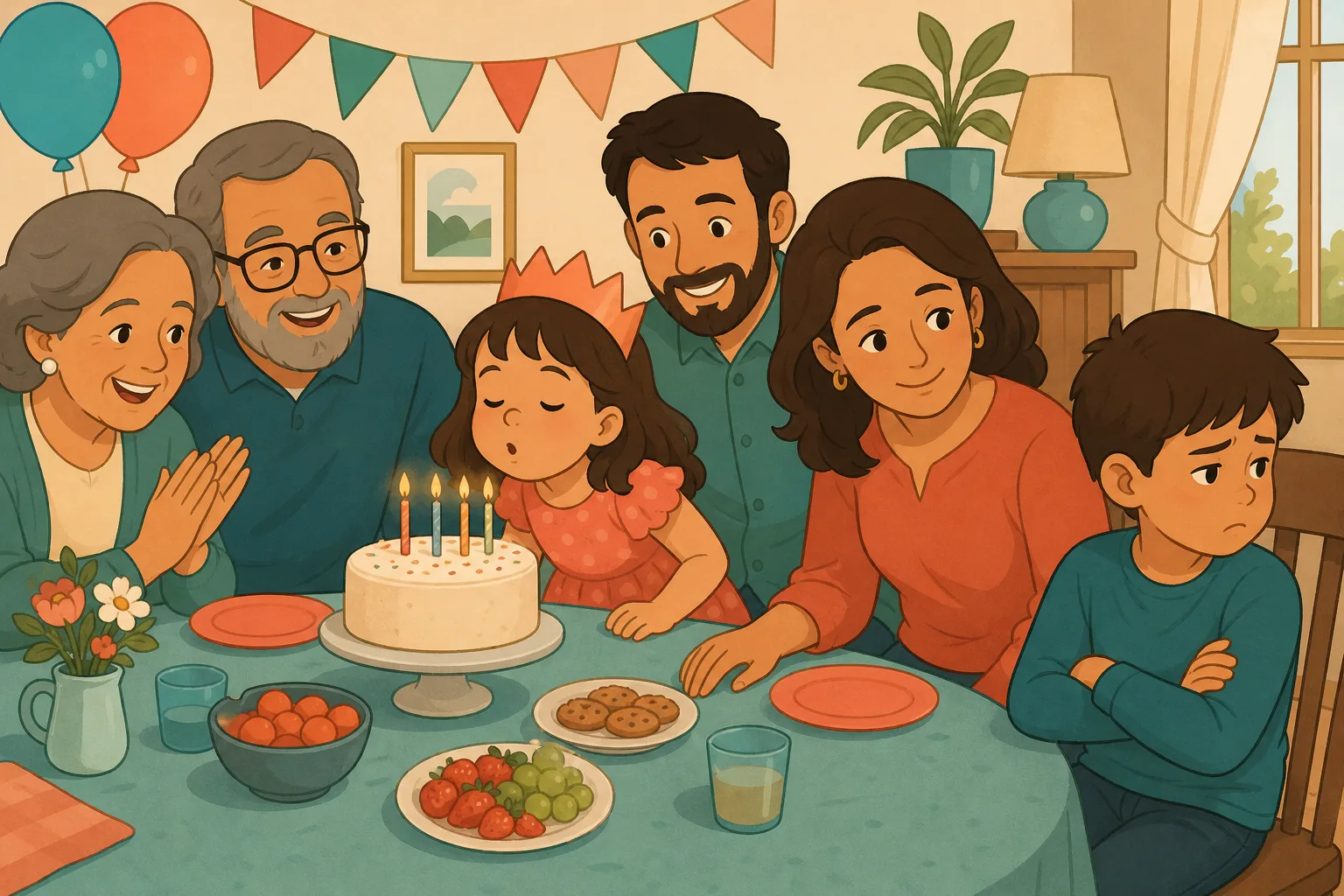
Rachel is at a friend's birthday party with Chloe, twenty months old, on her hip when someone asks the question for the third time that month: "So, when's the next one?"
That evening, she and Tom sit at the kitchen table with a calendar. If they started trying now, Chloe would be about two and a half when the baby arrives. Rachel's sister had her boys sixteen months apart and still describes those years as "survival mode." A friend from work has children six years apart and says it feels like raising two only children. Tom's mother is sure that three years is perfect. Everyone has an answer, and none of the answers match.
If you are in the same place, this guide will not give you a magic number, because there is not one. What it can give you is an honest picture: what each gap tends to bring, what the health guidance on spacing actually says (and what it does not), and how to help your children get along with whatever gap you end up with.
- ✓There is no ideal age gap between siblings. Every spacing brings its own easier and harder parts, for parents and for the children
- ✓Health guidance measures something different: the time from one birth to the next pregnancy. WHO recommends at least 24 months, and a large meta-analysis found the lowest risks at 18 to 23 months
- ✓Close gaps tend to mean an intense first few years and playmates sooner; bigger gaps mean a more independent older child and a different kind of sibling bond
- ✓Rivalry happens at every gap. What changes is what it looks like and what the older child needs from you
- ✓Whatever your gap, the same things help: time alone with each child, protected space for the older one, and not expecting both to be the same
Is there an ideal age gap between siblings?
No, and it is worth saying clearly, because a lot of what you will read about "the perfect gap" is personal experience presented as a rule. Parents with children two years apart often swear by two years. Parents with children five years apart often swear by five. Both are describing their own family, which is real, but it is not evidence that one gap is better.
What research does show is that how siblings get along depends on many things besides age. Raising Children Network, the Australian government-funded parenting site, names skills, temperament, age and the environment children grow up in as the main reasons siblings fight, and notes that most siblings fight less as their social and problem-solving skills develop (Raising Children Network). A flexible child and a persistent, quick-to-react child will clash at any age gap.
Age does play a role in one interesting way. A meta-analysis of 34 studies with more than 12,000 children found that the link between sibling conflict and children's emotional and behavior problems was stronger when siblings were closer in age (Buist et al., 2013). That does not mean close siblings fight more. It suggests that when children are close in age, the quality of their relationship matters a lot, so it is worth investing in.
There is also some evidence about school. A US study that used miscarriages as a natural experiment found that each extra year between siblings was linked to somewhat higher test scores for the older child, and found no effect for the younger child (Buckles & Munnich, 2012). It is one study from one country, and plenty of other things matter more for how a child does at school. But it fits what many parents notice: an older child gets a few more years of undivided attention before a sibling arrives.
What does health guidance say about spacing pregnancies?
This part is about the mother's and the baby's health, not the sibling relationship, and it uses that second measure: the time from a live birth to the start of the next pregnancy.
The World Health Organization recommends waiting at least 24 months after a live birth before trying for the next pregnancy, to reduce the risk of problems for mother and baby. The same WHO report is clear that this is not the only thing that counts: it asks couples to weigh health risks alongside their age, fertility, access to health care, support with childcare, their circumstances and their personal preferences (WHO).
The research behind the advice points in the same direction. A meta-analysis of 67 studies compared different intervals with an interval of 18 to 23 months between a birth and the next pregnancy. Intervals shorter than 6 months were linked to a higher risk of preterm birth, low birth weight and babies who are small for their age, and intervals of 6 to 17 months and longer than 59 months were also linked to a greater risk (Conde-Agudelo et al., 2006).
A newer study adds an important nuance for families in wealthier countries. Researchers looked at more than 5.5 million births in Australia, Finland, Norway and California and compared pregnancies of the same women. Very short intervals, under 6 months, were linked to a higher risk of spontaneous preterm birth, and intervals of five years or more were linked to higher risks across all the outcomes they studied. The authors concluded that the advice to wait at least 24 months may be unnecessarily long in high-income countries (Tessema et al., 2021).
In plain numbers: a birth-to-pregnancy interval of 18 to 23 months means children born roughly 27 to 32 months apart, a little over two years to not quite three. Waiting 24 months means a gap of about 33 months.
What each age gap tends to bring
What follows is a mix of what we know about children's development at each age and what parents commonly describe. Where there is no research behind a point, it is experience, so read these as tendencies, not predictions.
Less than 2 years apart
Your older child is still very much a baby or young toddler when the new one arrives. They will not understand much of what is happening, and they cannot yet wait, share or be gentle on request.
What tends to be easier: the older child may adjust without a long memory of being the only child, and the two are close enough in age to become playmates early. The baby years, with their gear, naps and broken nights, come in one concentrated block rather than twice.
What tends to be harder: the first two or three years are physically intense. You may have two children who need carrying, feeding and changing at the same time, and very little sleep. The older child's needs do not pause because the baby arrived, and they cannot tell you in words what is wrong.
What helps: lower your expectations of the older child to match their age, keep routines simple, and accept every offer of help you can.
You're the big sister now. You have to be gentle with the baby.
Soft hands on the baby. Let me help you. Here, you can stroke her foot.
2 to 3 years apart
Your older child is in the middle of the toddler years: big feelings, strong opinions and limited patience. Raising Children Network describes children of three and four as just starting to cooperate, share and take turns, still learning to manage strong emotions like frustration, and sometimes still expressing frustration physically, by pushing (Raising Children Network).
What tends to be easier: a two- or three-year-old can understand a little of what is coming, can be involved in simple ways, and can start to name feelings. The children are close enough in age that they will probably play together within a few years.
What tends to be harder: a newborn arriving in the middle of the toddler years can mean tantrums and a crying baby at the same time. Many children this age also go through other big changes, like toilet training, starting childcare or moving to a big bed, and stacking those onto the baby's arrival makes everything harder.
What helps: if you can, make other big changes a few months before or after the baby arrives, not the same week. Protect a few minutes alone with the older child every day, and expect some going backwards in sleep, toileting or clinginess. Our guide to preparing your child for a new sibling goes through this stage step by step.
3 to 5 years apart
Your older child is in preschool or kindergarten, more independent and able to wait a little. They have their own friends, their own interests and a life outside the family.
What tends to be easier: an older child at this age can talk about what they feel, help in small ways and understand that the baby needs a lot of care. Many parents find they have more physical capacity for a baby when they are no longer also carrying a toddler.
What tends to be harder: the older child has had several years as the only child, and losing your exclusive attention can feel like a bigger loss. Their play is more complex, and a crawling baby who knocks over the block tower or chews the puzzle pieces is a daily source of conflict. The baby may also arrive just as the older child starts school, which is a lot of change at once.
What helps: give the older child space and things the baby cannot reach, keep their activities and friendships going, and give them a real role without making them responsible. The section on big kid vs. little kid in our guide on how to stop siblings from fighting has more on this.
More than 5 years apart
Your older child is at school, can follow what is happening and put feelings into words, and may be genuinely excited to help.
What tends to be easier: the older child is independent in many ways, and by the time the younger one is a toddler, the older one may be eight or nine. Raising Children Network describes children of eight to twelve as less physical and more verbal in conflict, with arguments that often center on fairness, privacy and belongings (Raising Children Network), which is a different kind of challenge than daily tug-of-war over toys.
What tends to be harder: the children have little in common for years, and family outings rarely suit both. The older child may have spent six or seven years as the only child and feel pushed aside. And it is easy to lean on a capable older child too much, until they feel more like a babysitter than a sibling.
What helps: keep some time and activities that are just for the older child, find small rituals the two can share (reading a bedtime story to the baby, a silly song only they do), and keep the older child's help optional.
You're old enough to watch your brother while I make dinner.
Do you want to show him the bubbles while I cook? If you'd rather do your own thing, that's fine too.
Twins and siblings born very close together
Twins and siblings born within about a year live through the same stage at the same moment: the same toys, the same milestones, the same need for your lap. They are also compared constantly, often by people outside the family. What helps is everything that lets each child be their own person: separate activities now and then, their own friends, one-on-one time with you, and as little talk as possible about "the twins" as if they were one unit.
What helps with any age gap
The gap shapes what your children's relationship looks like. It does not decide whether they will get along. These things help at every gap:
- Prepare the older child in a way that fits their age. A one-year-old needs routines that stay the same. A five-year-old needs to hear which things stay the same and which are going to be different.
- Give each child time that is only theirs. Ten minutes with your phone away counts. Many rivalries are really requests for attention.
- Protect the older child's things and time. Being the older sibling should not mean losing everything to a younger one.
- Do not make the older child a third parent. Help can be invited and appreciated, but it should not be expected.
- Explain differences instead of pretending there are none. Different ages mean different bedtimes and rules. Saying why ("you're seven, so you can stay up a bit longer") helps children see it as fair. Our guide to sibling jealousy goes deeper into "That's not fair!"
- Skip the comparisons. "When your sister was your age, she was already reading" puts children in competition, whatever the gap.
From the app
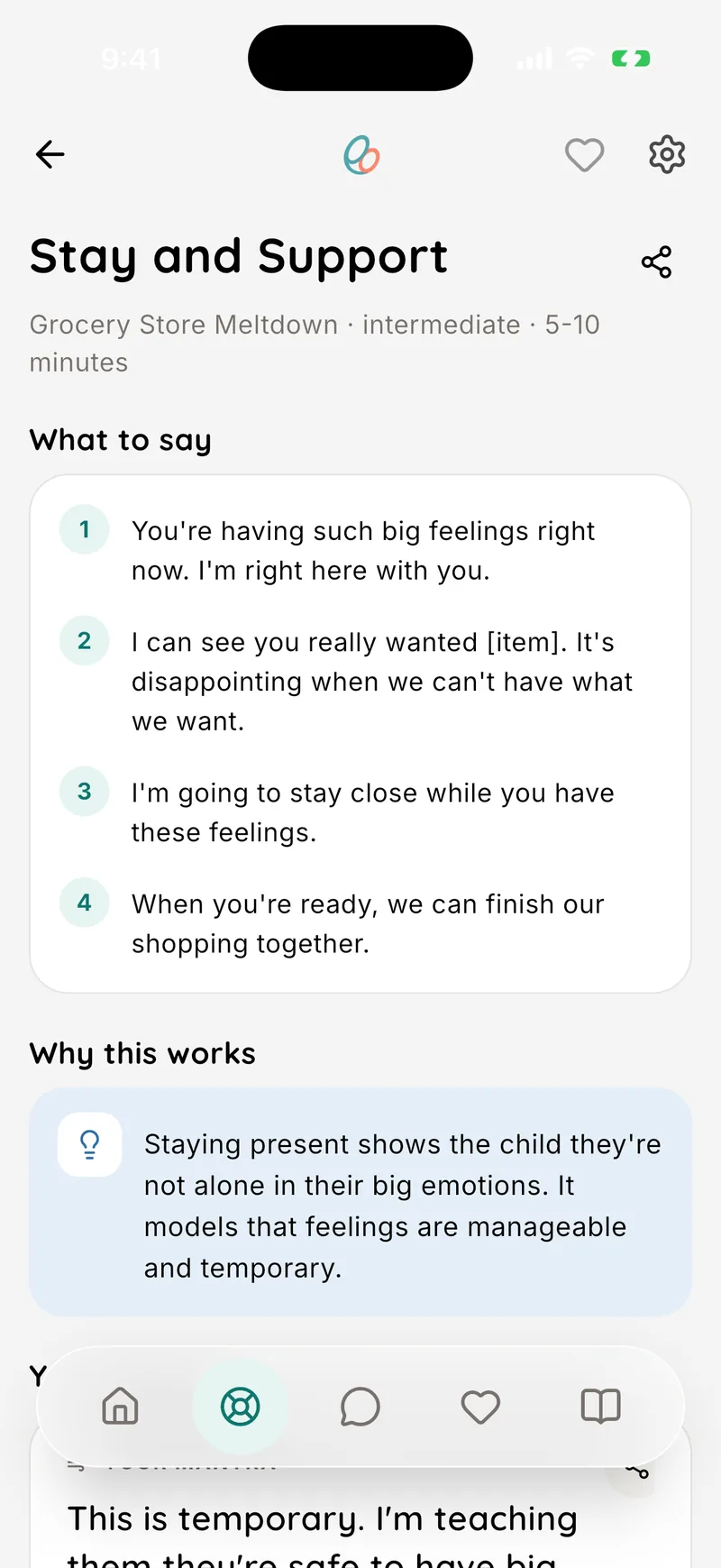
What to say when it happens
Two children are fighting, grabbing, or screaming over the same toy
Ages 2-10 years
Say this
- 1I see two kids who both want the same toy. That's really frustrating!
- 2I'm not choosing who gets it. You both want it - I get that.
- 3The toy's taking a break until you can work this out together.
- 4When you're ready to figure this out, I'll help you think of ideas.
Why it works
All 36 scripts are free in the app, no account needed.
For the bigger picture of why siblings compete and what helps day to day, see our guide to sibling rivalry.
Questions parents ask about sibling age gaps
"My kids are 18 months apart and I am exhausted. Does it get easier?"
For most families, yes. The hardest stretch with a close gap is usually the first two or three years, when both children need physical care at the same time. As the younger one starts to talk, walk well and play, the two often begin to entertain each other. Until then, cut every corner you can, and do not measure yourself against parents with a bigger gap.
"Our second child came seven years after the first. Will they ever be close?"
Many siblings with big gaps become very close, especially as they get older and the age difference matters less. In the early years, the relationship is more often teacher and student, hero and fan, than equal playmates. Small shared rituals and plenty of time where the older child is not responsible for the younger one help that bond grow.
"Is it unfair to my first child to have another baby quickly?"
No. Children adjust to siblings at every age, and having a sibling close in age has its own advantages. The fairness that matters to your first child is not when the baby arrived but whether they still feel seen: time with you, their own things, and their feelings taken seriously.
"My older child keeps asking why the baby gets so much attention. What do I say?"
Be honest and specific: "Babies can't do anything by themselves yet, so they need a lot of help. You got exactly this kind of help when you were tiny." Then follow it with something only for the older child, so the explanation is not the only thing they get.
"Does a bigger gap mean less fighting?"
It often means different fighting. Children far apart in age compete less over the same toys, but they can still clash over space, privacy, attention and fairness. And children close in age, who do compete for the same things, can also be the most devoted playmates.
Where to go next
- Why siblings compete in the first place: sibling rivalry: why it happens and what helps
- A new baby is coming or has just arrived: preparing your child for a new sibling
- When it turns into fights: how to stop siblings from fighting, and what to say
- "That's not fair!" and "You love her more!": sibling jealousy: why it happens and what to say
- Jealousy of the baby: what to say when your child is jealous of the new baby
- Ready-to-use words for the hardest sibling moments: RootWise for siblings
Sources
- World Health Organization: Birth spacing, report from a WHO technical consultation (policy brief)
- Conde-Agudelo, A., Rosas-Bermúdez, A., & Kafury-Goeta, A. C. (2006). Birth spacing and risk of adverse perinatal outcomes: a meta-analysis. JAMA, 295(15), 1809-1823.
- Tessema, G. A., Marinovich, M. L., Håberg, S. E., et al. (2021). Interpregnancy intervals and adverse birth outcomes in high-income countries: An international cohort study. PLoS One, 16(7), e0255000.
- Buist, K. L., Deković, M., & Prinzie, P. (2013). Sibling relationship quality and psychopathology of children and adolescents: a meta-analysis. Clinical Psychology Review, 33(1), 97-106.
- Buckles, K. S., & Munnich, E. L. (2012). Birth spacing and sibling outcomes. Journal of Human Resources, 47(3), 613-642.
- Raising Children Network: Why siblings fight: skills, temperament, environment and age
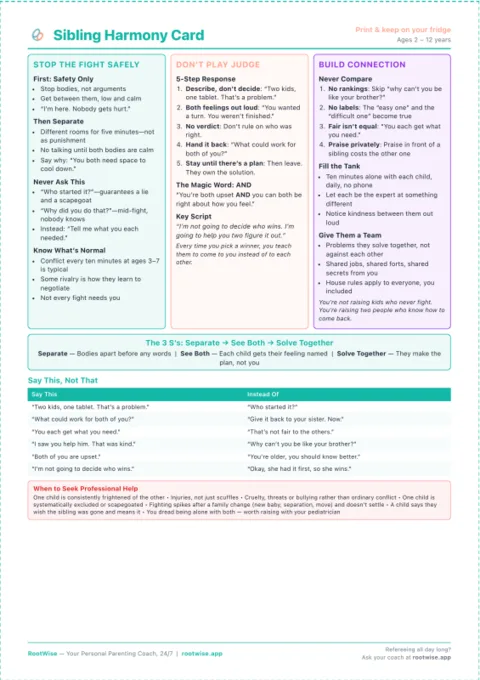
Sibling Harmony Toolkit
Stop sibling teasing and build family harmony with both-child approaches, empathy exercises, and conflict resolution strategies.
- The question never to ask when they fight
- Five steps to stop a fight without a judge
- How to make them a team instead of rivals
Frequently Asked Questions
Need personalized support?
Ask RootWise about your own situation and get an answer for your child's age, 24/7, when you need it most.
Get the app