Sibling Rivalry: Why It Happens and What Helps


Table of Contents
It is 5:40 on a Tuesday and Maya is draining pasta when the shouting starts. Theo, who is six, has laid a sock down the middle of the couch. Everything on his side is his. Ruby, three, has put one finger across the sock, and she is looking straight at him while she does it.
By the time Maya gets there, Theo is red in the face, Ruby is wailing, and both of them are talking at once. "She did it on purpose!" "He pushed me!" Maya does not know who started it. She suspects it does not matter. And she has the thought most parents of more than one child have had at some point: why can't they just get along?
If this feels familiar, you are not doing something wrong. Sibling rivalry is one of the most common challenges in family life, and also one of the most misunderstood. This guide explains why siblings compete, how much is normal, where the line to bullying is, and what helps, both in the moment and in the calm hours between fights.
- ✓Sibling rivalry is normal: a moderate amount is a healthy sign that each child can stand up for their own needs
- ✓Most fights come from skills that are still developing, plus temperament, age gaps and competition for your attention
- ✓Rivalry goes both ways; bullying is one-sided, repeated and frightening, and it needs adult action
- ✓Stepping in calmly as a coach, not a referee, helps children argue more constructively over time
- ✓Comparisons, rescuing the same child every time and forced apologies tend to make rivalry worse
What is sibling rivalry, and how much is normal?
Sibling rivalry is the competition between brothers and sisters: for attention, for space, for toys, for being first, for being right. It shows up as arguing, tattling, teasing, grabbing and sometimes hitting. It also shows up in quieter ways, like a child who suddenly needs help with things they could do on their own last week.
It helps to know how early it starts. In a classic home study of toddlers and their older siblings, researchers observed children as young as two already making up after a fight, teasing, and referring to family rules in their quarrels (Dunn & Munn, 1986). Rivalry is not something children pick up from bad examples. It comes with having a sibling.
The American Academy of Pediatrics describes moderate sibling rivalry as a healthy indication that each child is assertive enough to express their needs and wants (AAP). The Australian government-funded Raising Children Network puts it simply: fights and arguments are common among siblings, and most siblings fight less as they develop better skills (Raising Children Network).
So the goal is not a home without fights. The goal is fights that stay safe, stay fair, and end with your children a little better at sorting things out than they were before.
Why do siblings fight?
When you are in the middle of the third argument before breakfast, it can feel random. It usually is not. A few causes come up again and again.
They are competing for you
You are the most important person in your children's world, and there is only one of you. Much of sibling rivalry is really a question your children cannot put into words: do you love me as much as you love them? That is why fights so often break out the moment you sit down with one child, pick up the phone, or start feeding the baby.
Fairness is part of this. Children watch closely who gets the bigger piece, the front seat, the later bedtime. To a child, being treated differently can feel like being loved differently, even when the difference makes perfect sense to you.
Their skills are still under construction
The single most useful thing to remember: your children fight because they do not yet have the skills to solve the problem another way. Raising Children Network describes how fights start when children see a situation as unfair, feel that their sibling does not see their side, or want to defend what they think are their rights (Raising Children Network). An older child may think teasing is a joke while the younger one is genuinely hurt. Neither of them is a bad kid. They are both missing a skill.
Temperaments clash
Children are born with different temperaments. One of yours may be flexible and easygoing while the other is persistent, sensitive and quick to react. Put those two in a car for an hour and sparks are almost guaranteed. Temperamental differences explain why the same situation sets off one child and not the other.
Age and the gap between them
The way children handle conflict changes with age. Very young children often push and grab because they have the frustration but not the words. School-age children argue more and hit less, and their fights increasingly center on fairness, privacy and belongings. A big age gap brings its own friction, when a toddler keeps destroying an older child's building project, and so does a small one, when two children are at the same stage and want the same things at once.
What they see around them
Children learn how to handle disagreement by watching the people around them. When parents work through their own conflicts calmly, children copy it. Raising Children Network also notes that children who are disciplined with physical punishment are more likely to be physically violent with their siblings, as are children who often see adults being aggressive or who get what they want by pushing (Raising Children Network).
And then there are the ordinary multipliers: hunger, tiredness, too much screen time, a new baby, a move, a stressful week at work for you. If the fights spike at 5 p.m., they may have less to do with each other than with an empty tank.
When is it more than sibling rivalry?
Most sibling conflict is ordinary rivalry. Some of it is not, and it is important to tell the difference, because sibling aggression is often brushed off as "just kids being kids."
Researchers who analyzed a national U.S. sample of 3,599 children and teenagers found that those who had experienced aggression from a sibling in the past year, including milder forms like taking or breaking their things and mild physical attacks, reported more mental health distress. Sibling aggression and peer aggression each predicted worse mental health on their own (Tucker et al., 2013). A large UK study that followed more than 6,900 young people found that those who had been frequently bullied by a sibling at age 12 were about twice as likely to have depression and to self-harm at age 18 (Bowes et al., 2014).
Those findings describe an increased risk, not a certain outcome. But they make one thing clear: being hurt over and over by a sibling is not harmless, and children cannot be expected to fix it on their own.
Rivalry usually looks like this:
- Both children start fights, and both win some and lose some
- The fight is about something specific, like a toy, a turn or a seat
- They are playing together again an hour later
Bullying usually looks like this:
- One child is almost always the one who hurts, and the other is almost always the one who gets hurt
- The hurting is repeated: hitting, threats, intimidation, deliberate humiliation, breaking the other child's things
- One child seems afraid of the other, avoids being alone with them, or gives in to keep the peace
How to handle sibling rivalry: what actually helps
There is no trick that makes siblings stop competing. What you can change is how fights go, and how your children feel about each other and about you afterwards.
Stay out of the small stuff, step in when it hurts
Not every argument needs you. If it is a simple disagreement and nobody is getting hurt, giving your children a chance to solve it on their own is part of how they build the skill. The AAP suggests letting simple disagreements play out, even if the children need some time apart first, and stepping in as a calm, neutral party when they cannot resolve it or when someone's physical or emotional well-being is at risk (AAP, HealthyChildren.org).
Step in when a fight turns physical, when the words get cruel, or when one child is clearly overpowered. And do not worry that stepping in makes things worse. In a study of 40 Canadian families with two- and four-year-olds, parents tended to step in during the most intense fights, and once they had, children used fewer power moves and more sophisticated negotiation (Perlman & Ross, 1997).
Who started it? I want the truth, right now.
Hands off, both of you. I can see two upset kids. Let's get calm first, then we'll sort this out.
Be a coach, not a referee
When you hand down a verdict ("Theo, give it back, you're older"), one child walks away feeling like the winner and the other like the one you love less. The problem itself stays unsolved, and the fight will be back tomorrow.
Coaching works differently. You help both children say what they want, hear the other side, and find a solution they can both live with. Researchers in Canada randomly assigned 48 families with children aged 5 to 10 to learn a simple form of mediation for sibling disputes or to carry on as usual. In the mediation families, children used more constructive ways of solving conflicts, compromised more often, showed less negativity when they later negotiated on their own, and understood their sibling's point of view better (Smith & Ross, 2007).
You do not need training to start. A simple sequence is enough:
- Calm and safe first. Separate the children if needed. Nobody can solve anything while they are flooded.
- One at a time. Each child tells what happened while the other listens. No interrupting, from them or from you.
- Say back what you heard. "Theo, you wanted the couch to yourself after school. Ruby, you wanted to sit near your brother."
- Ask for ideas. "What could we do so this works for both of you?" Let them suggest even silly ideas first.
- Agree and check later. Pick one idea, try it, and come back to it if it does not hold.
With toddlers, this shrinks to a sentence or two. With eight- and nine-year-olds, you can often skip straight to "What are your ideas?" and let them do most of the work.
Drop the comparisons
"Why can't you be more like your sister?" is one of the fastest ways to make rivalry worse. Even positive comparisons ("You're the tidy one") give children fixed roles to compete over. Raising Children Network specifically warns that lines like "You should have known better because you're older" or "You're the troublemaker" leave a child feeling more hurt and resentful (Raising Children Network).
Describe what each child is doing, without reference to the other.
Look how nicely your brother is sitting. Why can't you do that?
You're finding it hard to sit still tonight. Do you want to help me carry the plates?
Fair does not have to mean the same
Children ask for equal treatment, but what they actually need is to feel fairly treated. A six-year-old and a three-year-old can have different bedtimes, jobs and privileges. Raising Children Network makes the same point: fair treatment is not necessarily the same treatment (Raising Children Network). Try saying it out loud: "In our family, everybody gets what they need. Right now Ruby needs help with her shoes, and you need help with your homework later."
Give each child time that is only theirs
A lot of rivalry is really a request for attention. The AAP recommends building one-on-one time with each child into ordinary routines, like a chat at bedtime or a walk with the dog, so that each child knows they have your full attention without their siblings around (AAP, HealthyChildren.org). It does not have to be long; ten minutes with the phone away still counts. Give it a name, like "our time", so your child knows it is coming.
A few family rules everyone knows
Children feel safer when the limits are clear and the same for everyone. Keep the list short and concrete: "We don't hit." "We knock before going into someone's room." "We ask before we take." The AAP recommends exactly this kind of ground rule, with more frequent reminders for younger children (AAP, HealthyChildren.org). When a rule is broken, point to the rule rather than the child: "In our family, we don't hit. You can tell her you're angry."
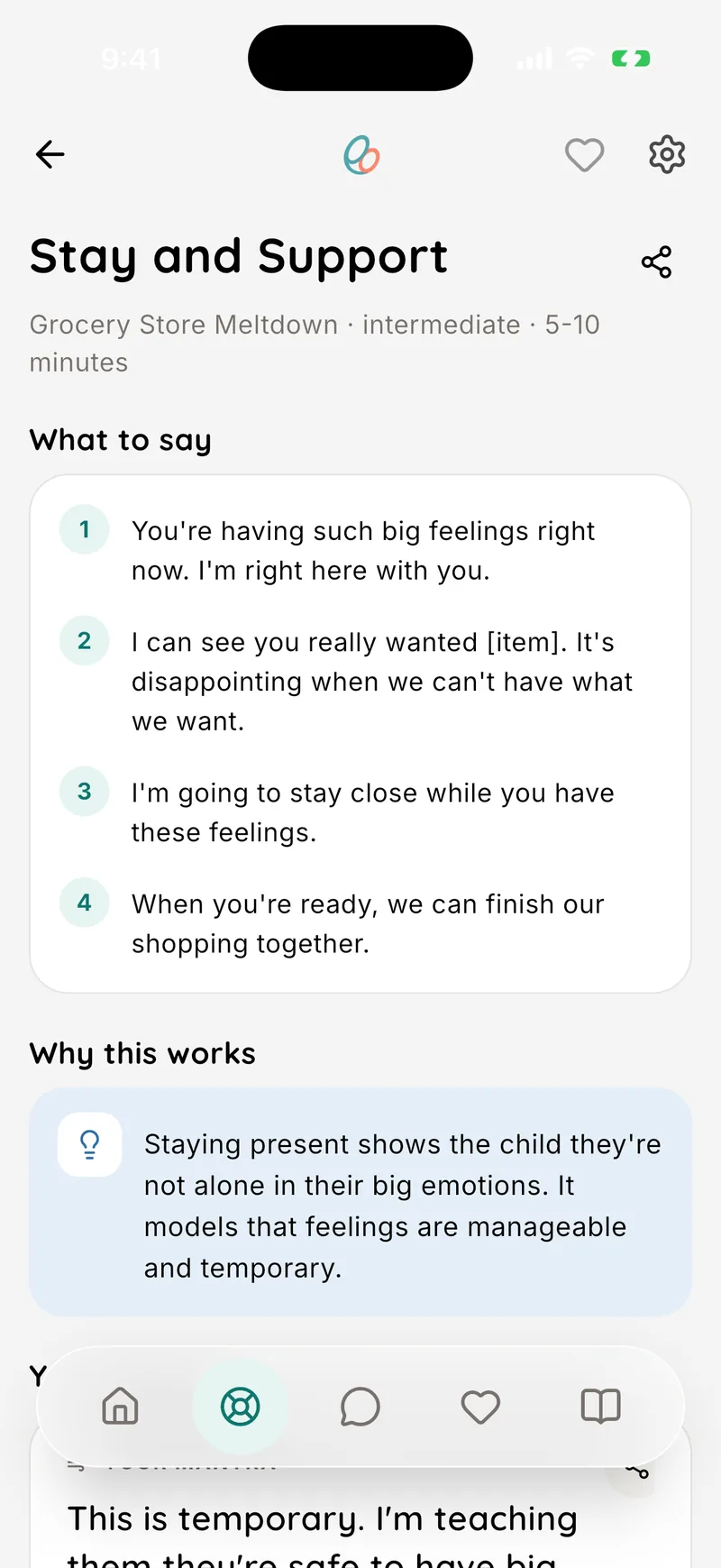
From the app
What to say when it happens
Two children are fighting, grabbing, or screaming over the same toy
Ages 2-10 years
Say this
- 1I see two kids who both want the same toy. That's really frustrating!
- 2I'm not choosing who gets it. You both want it - I get that.
- 3The toy's taking a break until you can work this out together.
- 4When you're ready to figure this out, I'll help you think of ideas.
Why it works
All 36 scripts are free in the app, no account needed.
Repair after the storm
What happens after a fight matters as much as the fight itself. Once everyone is calm, reconnect with each child on their own. The child who was hurt needs comfort. The child who did the hurting needs to know you still love them, and a way to make it right that is more than a mumbled "sorry": checking on their sibling, fixing the tower, offering the next turn.
It also helps to notice the good moments out loud. When your children share, play together or solve a problem without you, tell them you saw it. Positive feedback makes those moments more likely to happen again (Raising Children Network).
Sibling rivalry at different ages
Baby and toddler (0 to 3)
With a baby in the house, rivalry is mostly the older child's. Some children become clingy or start acting younger again, some get rough with the baby, and many do neither. A review of 30 studies on the birth of a sibling found large differences between children: for some the time was disruptive, for others it was a step forward, and for others nothing much changed (Volling, 2012). If your toddler is rough with the baby, stay close, block the hit without drama, and name the feeling: "You're mad that the baby needs me so much right now." Our guide to preparing your child for a new sibling goes into this stage in detail, and here is what to say when your toddler hits the baby.
Preschool (3 to 5)
This is the age of grabbing, pushing and "Mine!" Three- and four-year-olds are just starting to cooperate and take turns, and they still often express frustration with their bodies. Expect to step in a lot, and keep your words short. A timer for turns, two of the most fought-over toys, and a simple rule like "you can play with it when they put it down" prevent many fights before they start. For the classic toy grab, see what to say when siblings fight over a toy.
School age (6 to 10)
Fights get more verbal and more about fairness: who sits where, who got more, who went into whose room. Children this age are increasingly able to solve problems without you, so this is when the coaching steps above pay off most. Teasing becomes a bigger issue too; if that is your family's main battleground, our guide to why siblings tease each other is the next read.
Questions parents ask about sibling rivalry
"My kids fight more than any other family I know. Is it my fault?"
Probably not, and other families likely fight more than you think when nobody is watching. Temperament, age and the gap between your children all shape how much they clash. What you can influence is how fights end and how often your children feel compared or overlooked.
"My older one always starts it. Shouldn't he be punished?"
Be careful with "always". The older child is often the one you see react, while the younger one's poke went unnoticed. Even when the older child really did start it, constant punishment tends to deepen the resentment that drives the rivalry. Hold the limit ("I won't let you hit"), then give that child extra one-on-one time and help putting their frustration into words.
"Should I make them apologize?"
You can invite an apology, but forcing one mostly teaches children to say the word. Wait until everyone is calm, then ask how they could help their sibling feel better. Making amends is a skill, and it grows with practice.
"How do I stay calm when they've been at it all day?"
Lower the bar for yourself. Your job is not to stop every argument, only to keep things safe and fair. If it is safe to do so, take a few slow breaths before stepping in, or let another adult take over for a few minutes. Your calm voice is one of the most powerful tools you have, because your children copy it.
"Will they ever be friends?"
Most siblings fight less as they grow and their skills improve. A long-term study even found that the way firstborn children behaved with friends before their sibling was born predicted how well they got along with that sibling as teenagers (Kramer & Kowal, 2005). Social skills learned anywhere carry over to home, so every bit of practice counts.
Where to go next
Sibling rivalry has many faces. Depending on what is happening in your home, these are the best next steps:
- A new baby is coming or has just arrived: preparing your child for a new sibling
- Fights and meltdowns between siblings: managing sibling fights and outbursts
- Teasing that keeps going too far: why siblings tease each other, and what helps
- The exact words for a toy fight: what to say when siblings fight over a toy
- Jealousy of the baby: what to say when your child is jealous of the new baby
- Ready-to-use words for the hardest sibling moments: RootWise for siblings
Sources
- American Academy of Pediatrics: Sibling Rivalry, AAP Books
- American Academy of Pediatrics, HealthyChildren.org: Sibling Relationships: How to Help Your Kids Build Healthy Bonds
- Raising Children Network: Why siblings fight and How to handle sibling fights
- Dunn, J., & Munn, P. (1986). Sibling quarrels and maternal intervention. Journal of Child Psychology and Psychiatry, 27(5), 583-595.
- Perlman, M., & Ross, H. S. (1997). The benefits of parent intervention in children's disputes. Child Development, 68(4), 690-700.
- Smith, J., & Ross, H. (2007). Training parents to mediate sibling disputes affects children's negotiation and conflict understanding. Child Development, 78(3), 790-805.
- Tucker, C. J., Finkelhor, D., Turner, H., & Shattuck, A. (2013). Association of sibling aggression with child and adolescent mental health. Pediatrics, 132(1), 79-84.
- Bowes, L., Wolke, D., Joinson, C., Lereya, S. T., & Lewis, G. (2014). Sibling bullying and risk of depression, anxiety, and self-harm. Pediatrics, 134(4), e1032-e1039.
- Volling, B. L. (2012). Family transitions following the birth of a sibling. Psychological Bulletin, 138(3), 497-528.
- Kramer, L., & Kowal, A. K. (2005). Sibling relationship quality from birth to adolescence: the enduring contributions of friends. Journal of Family Psychology, 19(4), 503-511.
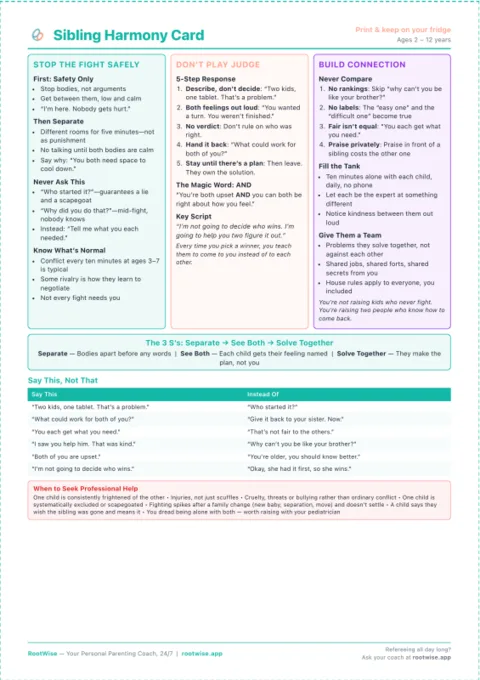
Sibling Harmony Toolkit
Stop sibling teasing and build family harmony with both-child approaches, empathy exercises, and conflict resolution strategies.
- The question never to ask when they fight
- Five steps to stop a fight without a judge
- How to make them a team instead of rivals
Frequently Asked Questions
Need personalized support?
Ask RootWise about your own situation and get an answer for your child's age, 24/7, when you need it most.
Get the app

