Favorite Child: What to Do If You Have One

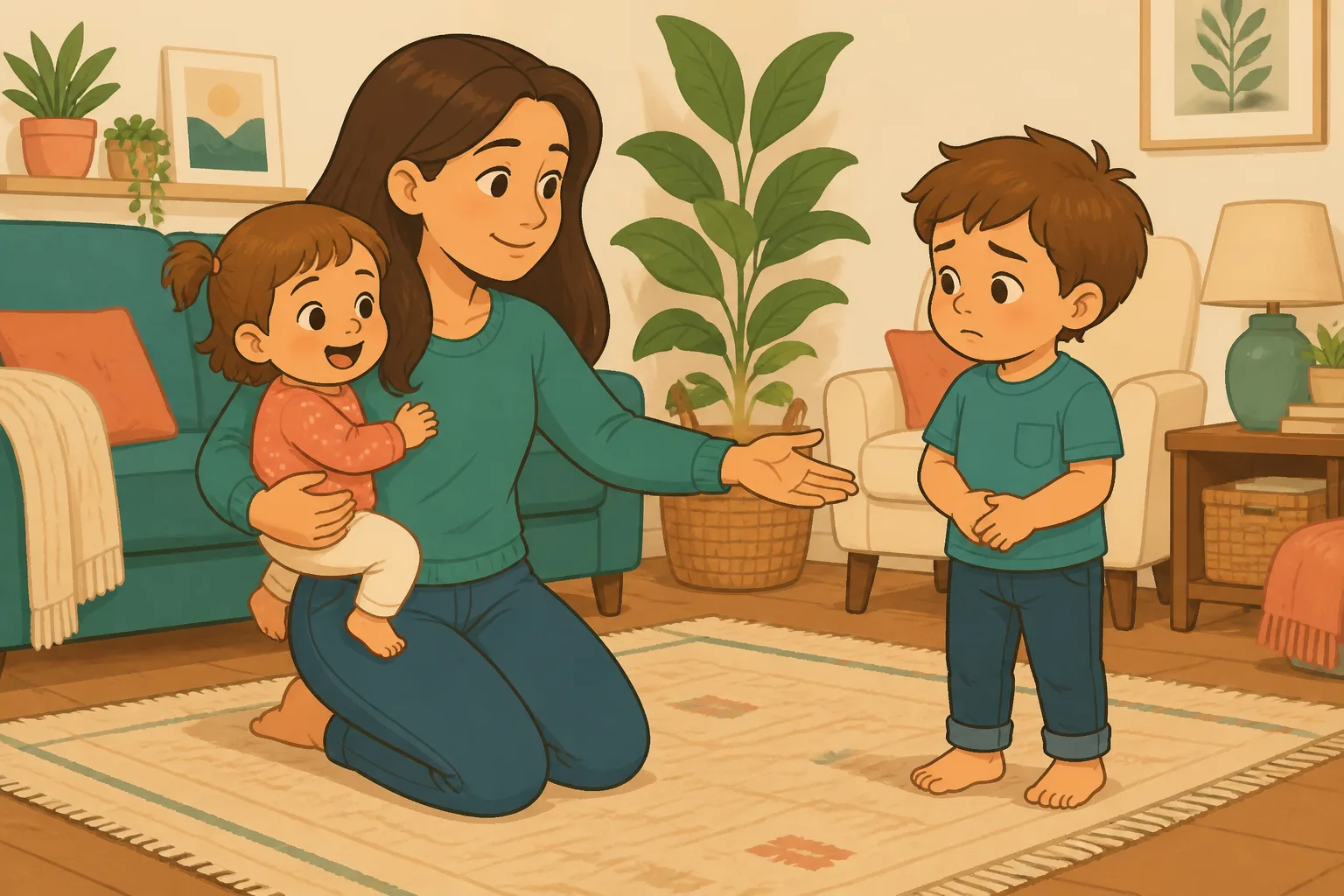
Table of Contents
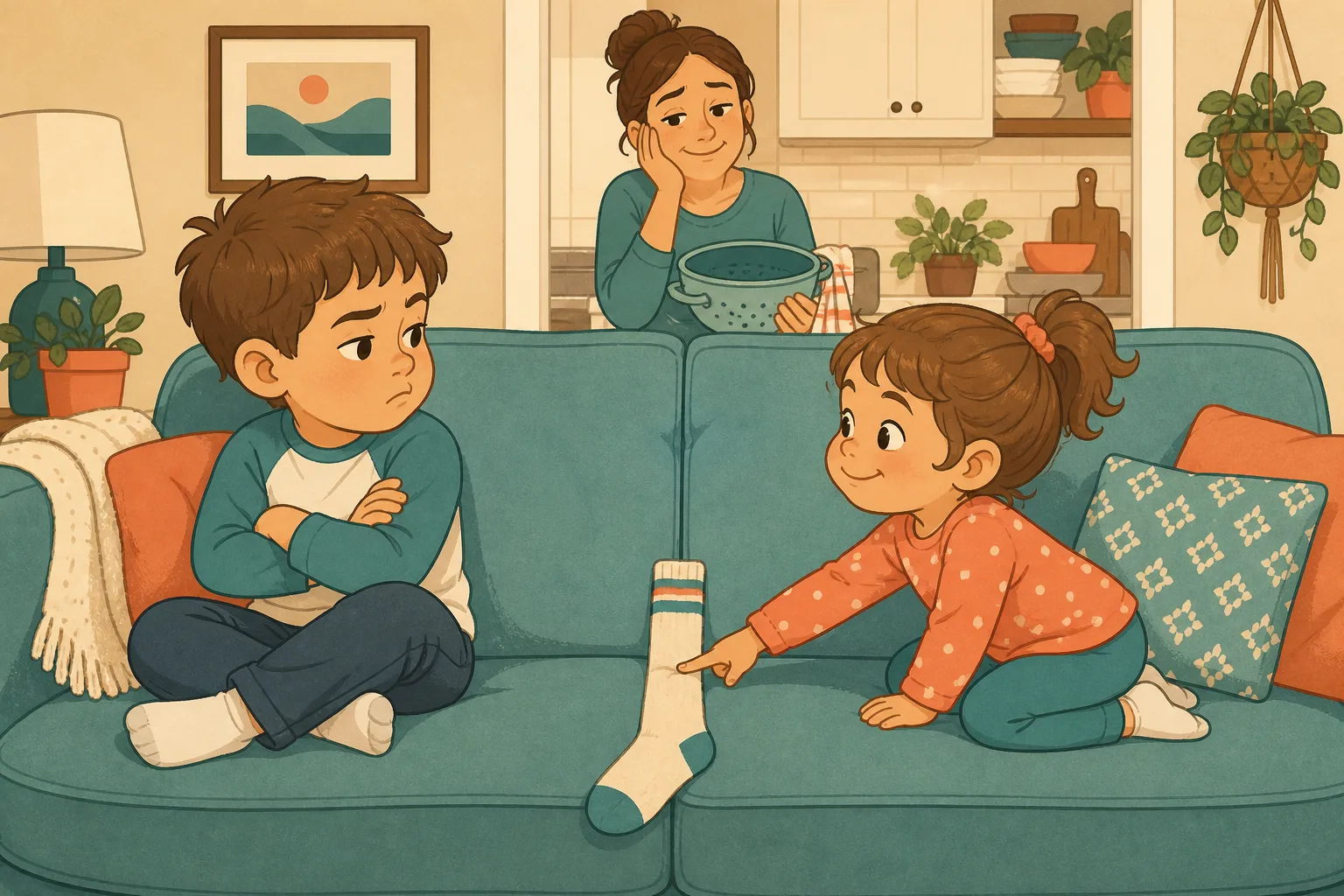
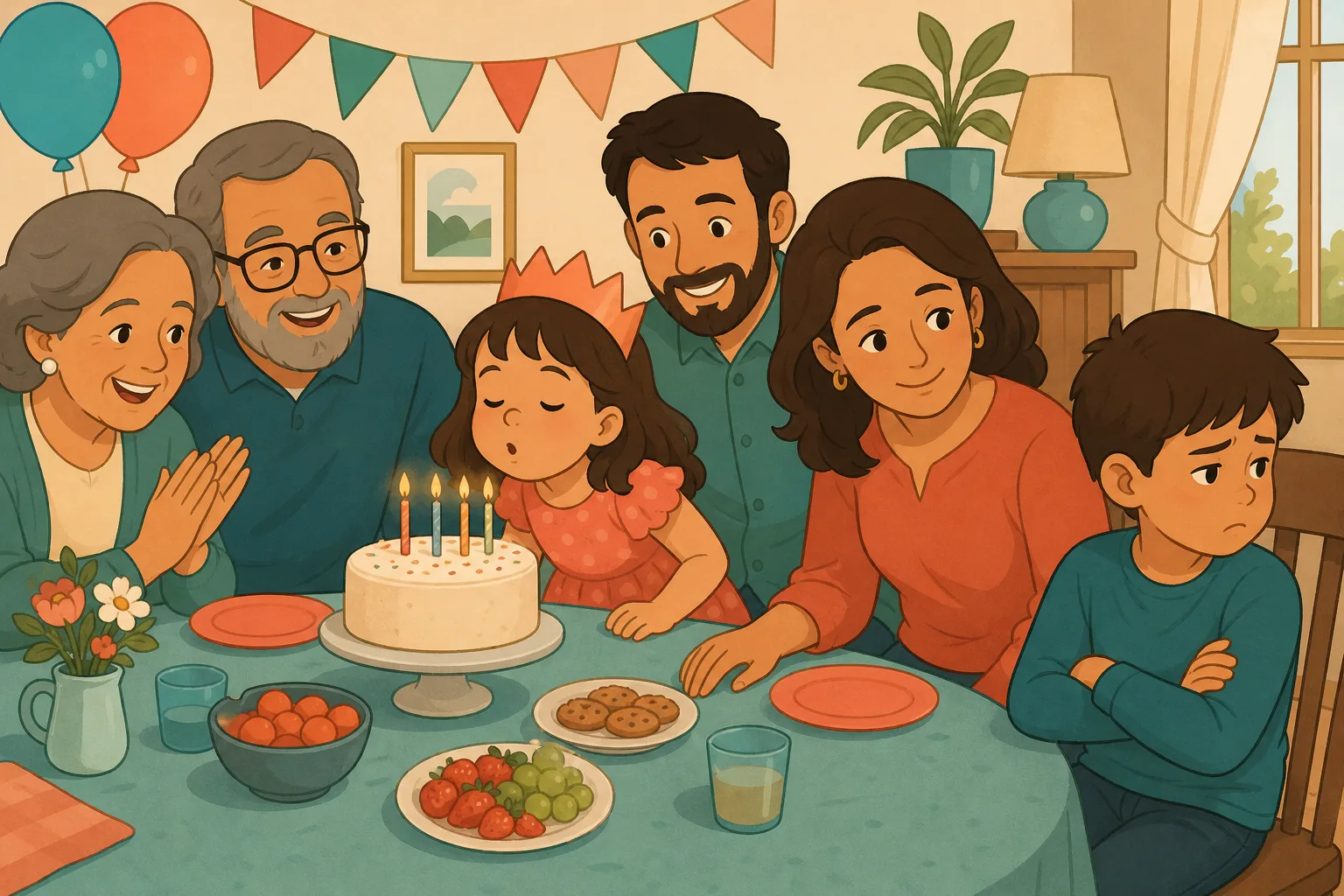
It is bath time, and Jess has a lapful of wet, giggling baby. Ivy, fourteen months, has just discovered that slapping the water makes a splash, and every splash makes her shriek with delight. Jess laughs with her. Then Noah, four, throws his pajamas on the floor. "I'm NOT going to bed. You can't make me."
Jess hears her own voice change. With Ivy it was soft and sing-song. With Noah it is flat and clipped: "Pick those up. Now." Later that night, lying awake, she asks herself the question most parents of more than one child have asked at least once and almost none say out loud: Do I love Ivy more?
If you have had a thought like this, you are in good company, and it does not mean what you fear. Feeling closer to one child at a given time is one of the most common and least talked-about experiences in family life. This guide looks at what research says about favoritism in families, why one child can feel so much easier than another, what children actually notice, and what you can do so that every one of your children feels loved for who they are. For the bigger picture of how siblings compete for your attention, see our guide to sibling rivalry.
- ✓Having a "favorite" is common: research suggests parents often treat children a little differently, often without noticing
- ✓In studies, favoritism mostly shows up in everyday treatment: warmth, conflict, freedom and rules, not in how much a parent loves a child
- ✓One child often feels easier because of temperament, age or a phase, and that can change from one year to the next
- ✓Differences children understand and see as fair are much less likely to hurt than differences that feel random or always go one way
- ✓What helps most: time that is easy with the harder child, the same rules for everyone, and saying why when things are different
Do parents really have a favorite child?
Most parents would say no. Research suggests the honest answer is "a little, sometimes, and often without realizing it."
A large 2025 meta-analysis in Psychological Bulletin pooled data from 19,469 people in 30 published studies and dissertations plus 14 other datasets, covering children, teenagers and adult children (Jensen & Jorgensen-Wells, 2025). The researchers looked at which children tend to get more favorable treatment. Their findings:
- Parents reported slightly favoring daughters.
- Conscientious and agreeable children received more favorable treatment. For conscientious children, the difference showed up mostly as less conflict with their parents.
- Older siblings tended to be given more freedom and autonomy, while the patterns for overall favoritism were more mixed.
The effects were small. This is not a story about parents secretly ranking their children. It is a story about how the child who follows the rules and rarely argues tends to get fewer battles and a little more ease, and how the child who pushes back tends to get more of the opposite. The authors' own conclusion is practical: parents and clinicians should know which children tend to be favored, so that potentially harmful patterns can be noticed.
Why one child can feel easier to love right now
Before you judge yourself, it helps to understand where the pull comes from. Most of what follows is not a research finding. It is what many parents recognize when they look honestly at their own family.
Temperament: some children fit you more easily
Children arrive with different temperaments. Some are easygoing and adaptable. Others are intense, sensitive or quick to say no. A calm parent may find a calm child effortless and a loud, persistent child exhausting. A lively parent may light up around the child who matches their energy. None of this is a choice. It is fit, and fit makes some relationships run smoothly and others take more work.
Phases: the cuddly baby and the four-year-old who says no
A baby who smiles at you all day is easy to adore. A four-year-old in a "no" phase, or a seven-year-old who slams doors, is harder to enjoy in the same moment. Many parents feel a pull toward the baby simply because the baby is not arguing yet. South Australia's government parenting service also points to the other side of this: some parents miss the relationship they had with their older child before the baby arrived, and recognizing those feelings helps you understand your child's feelings too (Parenting SA).
The child who reminds you of yourself
Sometimes a child shares your humor, your interests or your way of seeing the world, and closeness comes naturally. Sometimes a child reminds you of a part of yourself you do not like, or of a difficult person in your life, and every argument hits harder than it should. If one of your children "pushes your buttons" in a way the other does not, it is worth asking whose buttons they are really pushing.
When life is stressful
Stress narrows patience. In a stressful year, the child who needs the least from you can start to feel like the only easy part of your day, and the child who needs the most can start to feel like one more problem. That is human. It is also a sign to slow down, because the child who needs the most is often the one who most needs to feel liked.
Favoritism or fair differences: what children actually notice
Not every difference is favoritism. A toddler needs more help getting dressed than a nine-year-old. A child who is ill needs more of your time this month. An older child can stay up later. Parenting SA puts it simply: treating children equally does not necessarily mean treating them the same, and it helps to explain the reason for any differences (Parenting SA).
What children notice is rarely the big things. It is the small, daily ones:
- Warmth. Whose jokes you laugh at, whose drawing you look at properly, whose name you say in a soft voice.
- Conflict. Who gets told off first, who gets the benefit of the doubt, who is "always" the one who started it.
- Rules. Whether the same behavior gets the same response, whichever child does it.
- Freedom and privileges. Who gets to choose, who gets a yes more often.
Research with siblings shows why the explanation matters so much. In a study of 197 families with two teenage siblings, being treated differently by parents was linked to more sibling jealousy, and through that jealousy to more depressive symptoms, lower self-worth and more risky behavior. But for teenagers who saw the difference as fair, the link disappeared (Loeser et al., 2016). The study was with teenagers, but the lesson is easy to start with younger children: a difference that comes with a reason feels like a decision. A difference that comes with no reason feels like a judgment.
Ivy, sweetheart, come here. Noah! What did I just say?
Noah, I need you to pick those up, please. Thank you, buddy. Now come sit with me for a story before Ivy gets out of the bath.
What favoritism can do, and what it usually does not
When differences are large and lasting, children feel them. A meta-analysis of 34 studies with 12,257 children and adolescents found that less differential treatment by parents went along with fewer emotional and behavior problems. Notably, how much siblings fought with each other was an even stronger predictor than differences in treatment (Buist et al., 2013). The 2025 review summarizes decades of studies in the same direction: children who receive less favored treatment tend to do worse on a range of outcomes, and those who receive more favored treatment tend to do better (Jensen & Jorgensen-Wells, 2025).
The child who gets less can also turn the feeling on their sibling. Parenting SA notes that children who feel they are not treated fairly by their parents can sometimes become aggressive towards their siblings (Parenting SA).
The favored child does not always have it easy either. Many parents notice that being "the easy one" can come with an unspoken job: never being the problem, never being the one who struggles, and sometimes feeling guilty when a sibling gets the hard voice.
None of this means a few weeks of feeling closer to the baby will damage your older child. What research describes are patterns: differences that are large, that last, and that always go one way. Patterns are exactly what you can change once you see them.
If you recognize yourself: what helps
Notice the pattern, without the guilt
Guilt tends to make parents either deny the feeling or overcompensate, and neither helps much. Curiosity works better. For a few days, simply notice: which child do you correct first? Whose good moments do you mention to your partner? Who gets the soft voice at bedtime?
Give the harder child time that is easy
The child you clash with most usually gets most of their time with you in conflict: getting dressed, homework, bedtime. They need some time with you where nothing is being asked of them. Parenting SA suggests spending time with each child on their own, doing things they enjoy (Parenting SA). Ten minutes of their game, their choice, with no correcting, can change the temperature of the whole relationship.
Look for one thing you genuinely enjoy
Not praise as a strategy. Real enjoyment. Maybe it is the way your stubborn five-year-old argues like a tiny lawyer, or the way your loud seven-year-old throws herself into everything. When you find it, say it: "I love how you never give up on a puzzle." Children can tell the difference between being managed and being liked.
Check that the rules are the same rules
Ask yourself honestly: if the easy child did what the harder child just did, would the response be the same? If the answer is no, adjust it. The 2025 review found that for conscientious children, the favored treatment showed up mostly as less conflict with their parents (Jensen & Jorgensen-Wells, 2025). Consistency is one of the simplest places to close the gap.
Say why when things are different
Different bedtimes, different jobs, more help for one child this week: none of it needs an apology. It needs a sentence of explanation, so the difference feels like a reason and not a ranking.
Talk with your partner or co-parent
In some families, each parent drifts toward a different child, often the one who shares their temperament or interests. That can feel balanced from the inside and still leave a child on the outside. Talk about it calmly, describe what you see without blame, and agree on small changes, like each parent taking regular one-on-one time with the child they are less naturally close to.
From the app
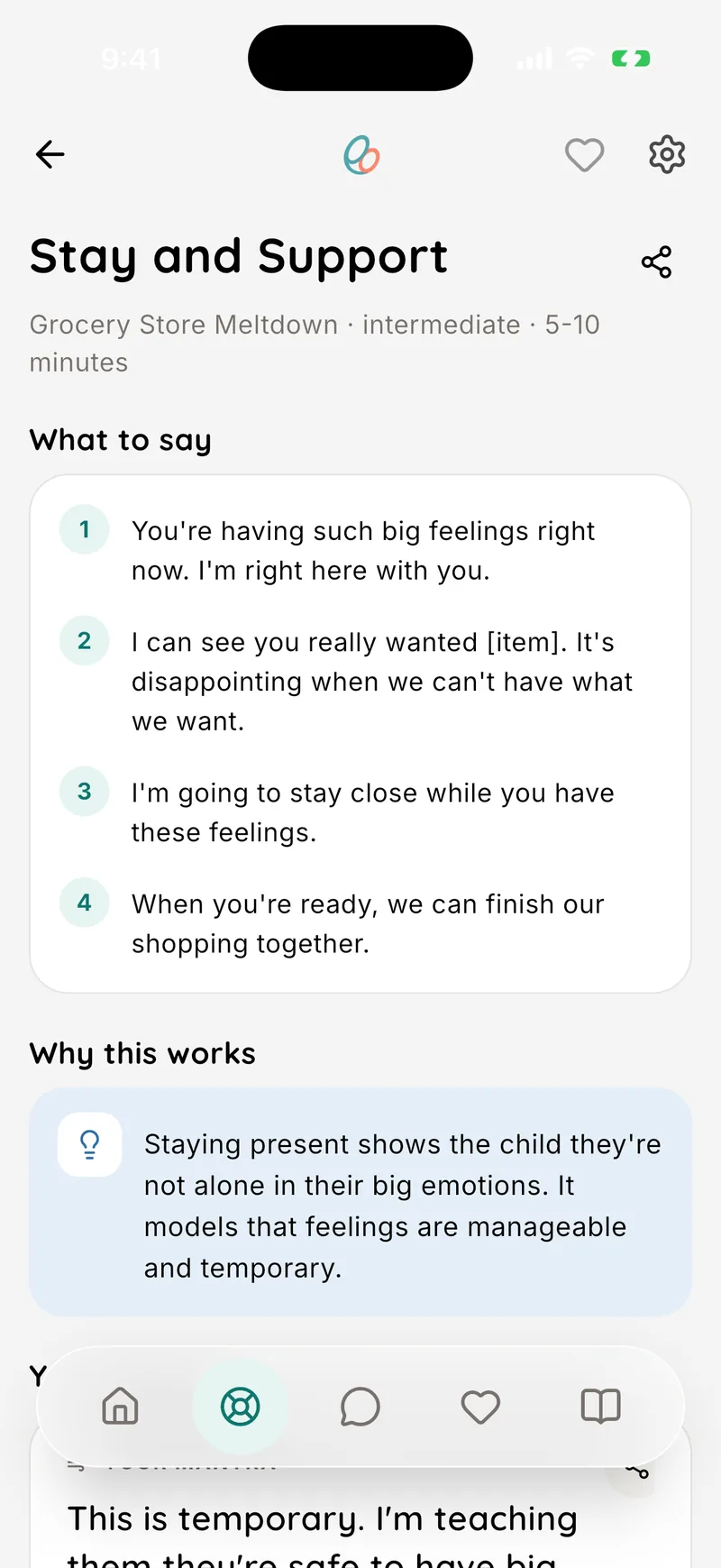
What to say when it happens
Two children are fighting, grabbing, or screaming over the same toy
Ages 2-10 years
Say this
- 1I see two kids who both want the same toy. That's really frustrating!
- 2I'm not choosing who gets it. You both want it - I get that.
- 3The toy's taking a break until you can work this out together.
- 4When you're ready to figure this out, I'll help you think of ideas.
Why it works
All 36 scripts are free in the app, no account needed.
What to say when your child asks "Who do you love more?"
Sooner or later, most children ask. Sometimes it comes in a calm moment at bedtime, sometimes as an accusation after a fight: "You love her more!" The quick answer, "I love you both the same," is true for most parents, but children often hear it as a way of ending the conversation.
What helps more is love that is specific. Children are not looking for a ranking. They want to know that their place cannot be taken.
Don't be silly. I love you both exactly the same, now go to sleep.
I love you as Noah. I love your jokes and the way you notice everything. Nobody else in the whole world could be you, and nobody could ever take your place.
If the question comes after you were sharp with that child, own it. Saying it out loud shows your child that what they noticed was real, and that it can be repaired.
If your child keeps returning to the feeling, the jealousy itself may need more attention. Our guide to sibling jealousy covers what to say when you hear "That's not fair!" and "You love him more!"
When to get support
Most parents who notice a pull toward one child can rebalance things on their own. Sometimes the feeling is a sign that something bigger is going on, in you or in your child.
Britain's National Health Service lists difficulty bonding with your baby among the symptoms of postnatal depression, and notes that fathers and partners can also have depression after having a baby (NHS). If you are worried about a child's behavior, Parenting SA advises contacting a health professional early, because early help gives a child the best chance of positive change (Parenting SA).
Questions parents ask about having a favorite child
"Is it wrong that I enjoy one of my children's company more?"
No. Enjoying time with one child more easily is a feeling, and feelings are not choices. It becomes a problem only when it turns into a lasting pattern of more warmth for one and more criticism for the other. Use the feeling as a signal to invest in the relationship that takes more effort, not as a reason for shame.
"My child clearly prefers my partner. Is that favoritism too?"
It is the same pull in the other direction. Many young children go through phases of wanting one parent for everything, and the favorite parent can switch more than once. Stay warm and available without competing, and keep doing your share of the bedtimes and bath times. For the exact words, here is what to say when your child wants the other parent.
"Should I ever tell my children that one of them is easier?"
Not in those words. Children hear "easier" as "better." You can be honest without ranking: "You and I sometimes butt heads because we're both stubborn. I love that about you, even when it's hard." That gives your child an explanation that does not make them the problem.
"My oldest says the baby gets everything. Is she right?"
Maybe, for now. Babies do need more hands-on care, and pretending otherwise rarely convinces anyone. Acknowledge it ("The baby does need a lot of me right now"), and then make sure your oldest gets something the baby does not: a later bedtime story, a grown-up job, a special outing. Our guide to preparing your child for a new sibling has more ideas for this stage.
"Will my children remember this as favoritism?"
What tends to stay with children is the pattern, more than any single moment. A hard month in which one child got more of your patience is not the whole story. What lasts is whether, over the years, each child felt seen, liked and treated fairly. That part is still in your hands.
Where to go next
- Why siblings compete in the first place: sibling rivalry: why it happens and what helps
- "You love her more!" and "That's not fair!": sibling jealousy: why it happens and what to say
- When it turns into fights: how to stop siblings from fighting, and what to say
- A new baby is coming or has just arrived: preparing your child for a new sibling
- When your child only wants the other parent: what to say when your child wants the other parent
- Ready-to-use words for the hardest sibling moments: RootWise for siblings
Sources
- Jensen, A. C., & Jorgensen-Wells, M. A. (2025). Parents favor daughters: A meta-analysis of gender and other predictors of parental differential treatment. Psychological Bulletin.
- Buist, K. L., Deković, M., & Prinzie, P. (2013). Sibling relationship quality and psychopathology of children and adolescents: a meta-analysis. Clinical Psychology Review, 33(1), 97-106.
- Loeser, M. K., Whiteman, S. D., & McHale, S. M. (2016). Siblings' perceptions of differential treatment, fairness, and jealousy and adolescent adjustment. Journal of Child and Family Studies, 25, 2405-2414.
- Parenting SA (Government of South Australia): Sibling conflict
- NHS: Postnatal depression
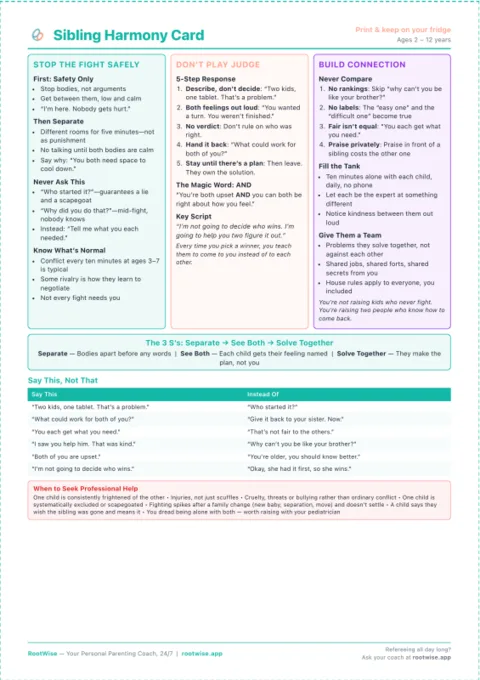
Sibling Harmony Toolkit
Stop sibling teasing and build family harmony with both-child approaches, empathy exercises, and conflict resolution strategies.
- The question never to ask when they fight
- Five steps to stop a fight without a judge
- How to make them a team instead of rivals
Frequently Asked Questions
Need personalized support?
Ask RootWise about your own situation and get an answer for your child's age, 24/7, when you need it most.
Get the app